
What Is GEO (Generative Engine Optimization) and Why It Matters in 2026
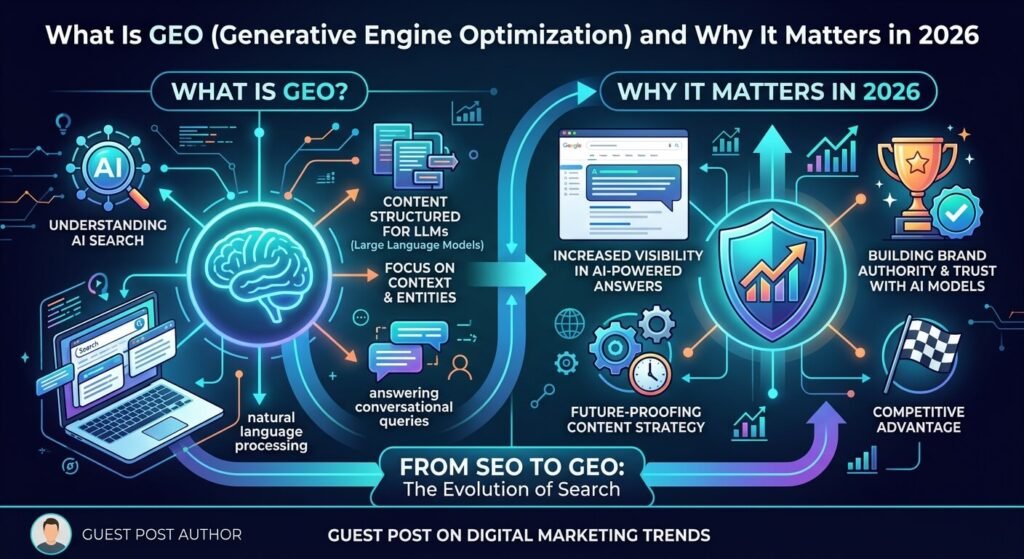
People now ask ChatGPT, Gemini, and Perplexity a question and read one written answer, and often they never scroll through a list of links. That shift is why generative engine optimization has become a serious topic for US business owners.
Generative engine optimization (GEO) helps AI systems find, understand, and cite your content. Google says AI Overviews now have over 2.5 billion monthly users, so the way people discover brands is changing fast.
This 2026 guide from UsaBusinessDaily answers what is GEO, how it works, and how it differs from SEO and AEO. You will also get ten strategies, a 12-point checklist, and a simple way to measure results.
@@ Image suggestion (hero): Google AI, ChatGPT, Perplexity, and Gemini feeding one AI answer that cites a website. Alt text: “Generative engine optimization in 2026 diagram”.
What Is GEO?
Generative engine optimization (GEO) is the practice of improving how content, brands, and websites are discovered, understood, mentioned, or cited by AI-powered search and answer systems. Those systems include Google AI Overviews, Google AI Mode, ChatGPT, Perplexity, Gemini, and Microsoft Copilot.
Consider a simple example. A homeowner in Texas asks an AI assistant, “How much does a commercial roof inspection cost?” Then the assistant writes one answer and cites a few sources. GEO is the work that helps your page become one of those sources.
In classic search, your page competes for a spot in a list. In AI search, your page competes to become part of the answer. In short, that is the core idea.
What Does GEO Stand For?
GEO stands for generative engine optimization. A generative engine is a search tool that uses a large language model (LLM) to write an answer. It does not only list links.
A research team that included Princeton University researchers introduced the term. Their paper first appeared in 2023 and was later presented at the ACM KDD conference in 2024. The team also built a benchmark called GEO-bench to test optimization methods.
In those experiments, some methods raised visibility in AI answers by up to 40%. However, results varied by domain and by method. That does not mean GEO lifts every website by 40%. Instead, it shows that content choices can change how often AI systems use a source.
How GEO Differs From Traditional SEO
You will often hear that GEO is “SEO for AI,” and that shortcut helps, but it hides real differences that matter for your content. SEO aims to earn rankings and clicks. In contrast, GEO aims to earn mentions and citations inside AI answers.
The two also share a base. Ahrefs analyzed 1.9 million AI Overview citations and found that 76% also ranked in the top 10 of regular results. So in practice, GEO SEO work is one strategy, not two. Strong SEO puts your page in the pool of sources. GEO then shapes whether the AI picks it.
!! Not sure whether AI tools can find and understand your website? Start with an AI visibility audit from UsaBusinessDaily.
How Does Generative Engine Optimization Work?
Most AI search tools follow a similar path, and although the details differ by platform, the overall flow stays consistent.
- A user asks a question.
- The AI interprets the intent behind it.
- The system retrieves pages from a search index or the web.
- It selects the sources that look most relevant and trustworthy.
- The model writes a combined answer.
- The answer shows citations or brand mentions.
Overall, GEO works on steps three to six. Your goal is to make your content easy to retrieve, easy to trust, and easy to quote.
@@ Image suggestion: vertical flow diagram of the six steps above (User Question, AI Interpretation, Retrieval, Source Selection, AI Answer, Citation or Brand Mention).
Google adds one more detail. It says AI Overviews and AI Mode may use a technique called query fan-out. The system runs several related searches across subtopics, then builds one response. So a single question can pull passages from many sites.
That has a practical effect. A Surfer SEO study, cited by Ahrefs, looked at this. Pages that ranked for fan-out queries were 161% more likely to earn an AI Overview citation than pages that ranked only for the main term. This is a correlation, not proof of cause. Still, it supports covering a topic from several angles.
Keep one caution in mind. AI answers are not fixed. Ahrefs notes that Google’s AI summaries can change with every refresh, and so can the cited URLs. So treat every result as a snapshot.
Why Does GEO Matter in 2026?
Four shifts explain why generative engine optimization matters now.
AI Search Has Reached Massive Scale
Google reports that AI Overviews now have over 2.5 billion monthly active users. AI Mode has passed one billion monthly users. Both figures come from Google’s own update for website owners, last updated on August 31, 2026. ChatGPT, Perplexity, Gemini, and Microsoft Copilot add more places where people ask questions.
Clicks Are Changing
Pew Research Center analyzed US browsing data in 2025. Users who saw an AI summary clicked a traditional result in 8% of visits. In contrast, users who did not see one clicked in 15% of visits.
Likewise, industry studies point the same way. Ahrefs reported a 34.5% drop in click-through rate linked to AI Overviews. Seer Interactive reported drops as high as 61%. The studies use different methods, so the numbers differ. The direction is the same.
Brands Get Discovered Inside the Answer
When an AI answer names your company, the reader sees your brand before they visit any site, and that mention also builds familiarity. If a competitor gets named and you do not, you miss that early moment. This matters most for small businesses, SaaS companies, and online stores. It also ties directly to wider ==AI trends== that change how buyers research.
Google Now Gives Site Owners More Data
Google began rolling out new Search Console insights for its generative AI features in 2026. They show impressions, plus which pages appear in AI responses and in which countries. Google says these tools reached all websites worldwide by August 31, 2026.
Google also introduced a control that lets site owners decide whether their content appears in these features. Sites that opt out receive no traffic or impressions from them.
The takeaway is simple. You can now measure part of your AI presence, so it deserves a place in your ==digital marketing strategy==.
GEO vs SEO vs AEO: What Is the Difference?
These three terms overlap. This table shows how they usually differ.
| Factor | SEO | AEO | GEO | | Main focus | Search rankings | Direct answers | AI-generated responses | | Target | Search engines | Answer systems | Generative engines | | Where you appear | Search results pages | Featured answers and snippets | AI answers and citations | | Content style | Keyword and intent optimized | Question-and-answer optimized | Source and entity optimized | | Main measure | Rankings and traffic | Answer visibility | Mentions and citations |
No industry standard exists yet. Sources use these terms in different ways, so treat the table as a practical guide, not a strict rulebook.
@@ Image suggestion: three-column infographic (SEO, AEO, GEO) based on the table above.
GEO vs AEO
Answer engine optimization (AEO) focuses on making content useful to systems that give direct answers. Ahrefs describes it as making content visible and useful to AI systems that answer questions directly. Featured snippets, voice answers, and AI assistants all fit here.
In comparison, people use GEO for the broader goal of appearing inside generative AI responses. The AEO vs GEO debate matters less than the shared habits. Both reward clear answers, trusted sources, and well-structured pages. Pick the term your team understands, then focus on the work.
What Is LLMO?
LLMO stands for large language model optimization. People use it for efforts to improve brand visibility in LLM-based tools, so some call it LLM optimization. It overlaps heavily with GEO and AEO. Some teams use the label AI SEO for all three.
How AI Search Engines Choose Sources
No public, universal “GEO algorithm” exists. Each platform retrieves and ranks sources its own way, and those methods change. Still, research points to several patterns.
- Search visibility matters. In the Ahrefs citation study, the median rank of the top-cited URL was position 2.
- Brand mentions track with visibility. Among the factors Ahrefs tested, branded web mentions had the strongest link to Google AI Overview appearances. That is a correlation, not proof of cause.
- Intent match beats length. Ahrefs found almost no correlation between word count and AI citations.
- Questions trigger AI answers. Ahrefs found AI Overviews on 57.9% of question queries, compared with 15.5% of non-question queries.
- Platforms differ. Ahrefs found that mentions on highly linked pages tracked strongly with Google AI Overview results but far less with ChatGPT.
Google’s own guidance adds more. It stresses unique content, clear page layout, good page experience, and high-quality images and video.
10 Key GEO Strategies for 2026
Good GEO optimization blends content, technical, and brand work. Use these ten strategies as a working plan.
1. Create Answer-First Content
Put a direct answer of 40 to 60 words right under each question heading. Then add detail below it. Ahrefs advises answering the query early, because burying the answer slows a model’s understanding of your page. Use question-based headings that match how people ask.
2. Demonstrate First-Hand Experience
Show what you did, not only what you know. For example, add original screenshots, test results, and named author bios. Google’s guidance asks for unique, non-commodity content. In contrast, content that repeats common advice gives an AI little reason to cite you.
3. Publish Original Research
Original data gives AI systems something new to cite, and even a small study works if the method is clear. For example, track 50 AI answers in your niche and publish which sources appeared. Explain how and when you collected the data.
4. Use Reliable Statistics
The Princeton study reported that adding statistics, citations, and quotations lifted results in its tests. So add numbers, but only from sources you can name. State the source, the year, and the method. Prefer primary sources such as Google, Pew, or academic papers over agency blogs.
5. Strengthen Entity Signals
An entity is a clearly defined thing, such as a company, person, product, or concept. Because AI systems need to know who you are, be consistent. Use one brand name, one description, and one set of facts across your website, social profiles, and directories. Add an About page, author pages, and Organization schema.
6. Build Topical Authority
Instead of chasing one keyword, cover a subject in depth. Publish a cluster of related pieces, such as ==SEO guides== and AI search explainers, and link them together with descriptive anchor text. Deep coverage also helps you match more of the sub-searches that AI tools run.
7. Use Structured Data Where Appropriate
Structured data helps machines read your page. Article, FAQPage, and Organization markup are low-risk choices. Stay realistic, though. Ahrefs notes there is no firm proof that schema improves AI Overview results. It also says Google and Microsoft have both stated that structured data helps AI systems interpret content.
8. Improve Technical SEO
AI systems cannot cite what they cannot access. First, make sure your pages are crawlable, indexable, and fast. Ahrefs notes that many AI crawlers read raw HTML and may miss content that loads only through JavaScript. So serve key text and schema in the HTML.
9. Earn Credible Mentions and Citations
Third-party mentions build trust for people and machines. To earn them, pitch expert quotes, guest articles, podcasts, and industry roundups. In its brand study, Ahrefs found that YouTube mentions had the strongest correlation with AI mentions. Aim for real, useful coverage. Avoid fake or forced placements. They give readers little reason to trust you.
10. Monitor AI Search Visibility
You cannot improve what you do not track. So run a fixed set of prompts each month. Record whether your brand appears, which pages get cited, and whether the facts are correct. Also add Search Console data. The measurement section below shows how.
!! Want to know how ready your website is for AI search? Get a GEO and SEO visibility audit.
@@ Image suggestion: checklist infographic of the ten strategies.
The UsaBusinessDaily 5C GEO Framework
To make the ten strategies easier to apply, UsaBusinessDaily uses a simple 5C framework. So a sound AI search optimization strategy should pass all five checks.
| The 5 C’s | What it means | First action | | Clarity | Answer questions fast | Add a 40 to 60 word answer under each question heading | | Credibility | Back claims with evidence | Cite primary sources and show dates | | Context | Show how ideas and entities connect | Build topic clusters and keep entity facts consistent | | Citations | Earn outside validation | Pitch original data and expert quotes | | Conversion | Turn discovery into action | Add a clear next step, such as an audit or checklist |
Use the 5Cs as a review filter before you publish. First, score each page against all five. If a page fails one C, fix it first.
A Practical Example
Consider a hypothetical US digital marketing agency that tests 50 AI queries about local advertising costs and records which sources each answer cites. It then publishes the findings as an article with a chart and a clear method note.
Next, the agency turns the data into a short infographic, pitches the results to trade publications, and shares expert commentary. Each step creates a new citable asset. Together, they strengthen the agency’s ==search visibility== and brand mentions. This example is illustrative, not a real case study.
How to Optimize Your Website for ChatGPT, Gemini, and Perplexity
ChatGPT SEO is not a separate discipline. It rests on the same base as classic SEO, plus attention to how AI tools retrieve and cite sources. Perplexity SEO works the same way. Platforms change often, so focus on habits that hold up across all of them.
- Check crawler access. Review your robots.txt file. Some sites block bots such as OAI-SearchBot (OpenAI’s search crawler) or PerplexityBot by accident. Decide on purpose.
- Write self-contained passages. Each section should make sense alone, because AI tools often pull a single passage.
- Keep brand facts consistent. Your name, services, locations, and pricing should match everywhere.
- Earn mentions where these tools look. Study which sites they cite for your topic, then aim for coverage there.
- Test real prompts. Ask each platform the questions your customers ask, and note who gets cited.
Results differ by platform, so track ChatGPT, Gemini, Perplexity, and Copilot separately. This work also fits into broader ==AI marketing== plans.
GEO and Google AI Overviews
Google AI Overviews SEO begins with normal search fundamentals. No trick guarantees a spot. Google says its AI features aim to send people to websites, and it has published guidance for site owners.
Three steps help most:
- Target question and “why” queries. Ahrefs found AI Overviews on 59.8% of reason-style queries, the highest rate of any type it studied.
- Rank well in regular results first. After all, most cited pages already sit near the top.
- Review the new Search Console insights, and think carefully before using the opt-out control. Opting out removes your site from traffic and impressions in those features.
GEO and E-E-A-T
E-E-A-T stands for experience, expertise, authoritativeness, and trust, and it comes from Google’s quality guidance. It is a framework, not a single score. Still, it gives a useful test for GEO, because AI tools want sources they can rely on.
- Experience: original photos, tests, and case notes.
- Expertise: named authors with real, checkable bios.
- Authoritativeness: mentions and citations from respected sites.
- Trust: clear dates, methods, sources, and corrections.
One rule matters most. Do not just tell AI systems that you are an expert. Build evidence of your expertise across the web.
How to Measure GEO Success
Rankings alone no longer show the full picture. Track these metrics.
- AI mentions: how often AI answers name your brand.
- AI citations: how often they link to your pages.
- Citation share: your citations divided by all citations across your test prompts.
- Brand accuracy: whether the AI states your facts correctly.
- AI referral traffic: visits from sources such as chatgpt.com or perplexity.ai in your analytics.
- Search Console impressions: Google’s generative AI insights.
- Branded searches and conversions: leads, sign-ups, and consultation requests.
Because AI answers change, sample more than once by running each prompt several times and recording the pattern, not a single result. Good AI search visibility tracking combines manual tests, analytics, and Search Console. Third-party tools can also help.
Together, five signals show your overall GEO success: SEO reach, AI reach, brand reach, referral traffic, and conversions.
@@ Image suggestion: simple measurement dashboard graphic (mentions, citations, citation share, brand accuracy, referrals, conversions).
12-Point GEO Readiness Checklist
- Answer each main question in 40 to 60 words near the top.
- Use question-based headings.
- Add an author name, bio, and dates.
- Cite a primary source for every key statistic.
- Include one original insight, example, or data point per article.
- Keep pages crawlable and indexable.
- Serve key text and schema in HTML.
- Add Article, FAQPage, and Organization schema where they fit.
- Keep brand facts consistent across profiles.
- Build topic clusters with descriptive internal links.
- Earn third-party mentions from trusted sites.
- Test prompts and review Search Console every month.
Common GEO Mistakes
Teams new to generative engine optimization often repeat the same errors.
- Treating GEO as a replacement for SEO. Weak SEO also shrinks your pool of possible sources.
- Stuffing keywords. However, the Princeton tests showed little gain from it.
- Publishing generic AI-written filler. Many teams use ==AI tools== to draft content. Without expert input and original data, the result adds nothing new.
- Blocking AI crawlers by accident, which cuts you off from retrieval.
- Leaving outdated facts on the page. Stale pages also lose trust, especially on fast-moving AI topics.
- Making claims you cannot support. Never say Google confirms a GEO ranking factor unless Google’s documentation says so.
- Judging results from a single test. AI answers vary, so repeat your checks.
Does GEO Replace Traditional SEO?
No. Generative engine optimization does not replace traditional SEO. It extends many SEO principles into AI-powered search experiences. Crawlability, quality content, authority, and clear structure still decide whether your pages get found. GEO adds a focus on being cited inside synthesized answers.
Our position at UsaBusinessDaily is simple. GEO expands SEO into a world where users often get one combined answer instead of only ranked links. A balanced ==SEO strategy== now covers both.
Do Businesses Need GEO Services?
Many businesses can start generative engine optimization in-house with the checklist above. However, outside help makes sense when you run a large site, sell many products, lack time, or work in a regulated field.
If you hire, ask direct questions:
- How do you measure your AI reach?
- Which prompts and platforms do you track?
- How do you separate SEO gains from GEO gains?
- Which sources support your recommendations?
Also, be wary of anyone who guarantees placement in AI answers. No one controls those answers. When you compare ==digital marketing agencies==, look for transparent methods and honest reporting.
The Future of GEO in 2026 and Beyond
Generative engine optimization is still young, and no one can predict AI search precisely. Still, several trends are already visible.
- Terms will keep shifting. GEO, AEO, and LLMO overlap, and sources still disagree on definitions.
- Measurement will improve. Google has added AI insights to Search Console and says more metrics will follow.
- Site owners will get more control. The new opt-out toggle is one early example.
- The basics will last. Clear, original, reliable, and easy-to-access content serves both people and machines.
For any ==online business==, the safest move is to build a brand that both people and AI systems recognize. Steady work on AI search today also supports long-term ==business growth==.
Frequently Asked Questions
What is GEO in SEO?
GEO, or generative engine optimization, improves the chance that AI search tools find, cite, or mention your content in their answers. It builds on SEO basics such as crawlability, content quality, and authority. It then adds a focus on AI answers.
What does GEO stand for?
GEO stands for generative engine optimization. A generative engine is a search or answer tool that uses a large language model to write a response. Google AI Overviews, ChatGPT, Perplexity, and Gemini are common examples.
How does generative engine optimization work?
An AI system interprets a question, retrieves pages, selects sources, writes an answer, and often shows citations. GEO makes your content easier to retrieve, trust, and quote. Overall, clear answers, original data, strong entities, and accessible pages all help.
Why is GEO important in 2026?
Google reports over 2.5 billion monthly users for AI Overviews and over one billion for AI Mode. Pew and Ahrefs data also show fewer clicks when AI summaries appear. Brands that AI tools name gain attention before any click happens.
Is GEO the same as SEO?
No. SEO mainly targets rankings and clicks in search results. GEO targets mentions and citations inside AI answers. They overlap heavily, because strong SEO puts your pages in the pool of sources that AI tools draw from.
What is the difference between GEO and AEO?
AEO usually focuses on giving direct answers, such as featured snippets and voice replies. GEO is more often used for broader visibility inside generative AI responses. The terms overlap, and the industry has not settled on strict definitions.
How do I optimize my website for ChatGPT?
Publish clear, original, well-sourced content. Keep your technical SEO healthy, and check that you do not block search bots by accident. Then keep your brand facts consistent, earn trusted mentions on other sites, and test real customer prompts every month.
Can GEO help with Google AI Overviews?
It can help, but nothing guarantees inclusion. Strong search rankings, unique content, clear page structure, and reliable sources improve your chances. Google also offers Search Console insights, so you can see how your pages appear in these features.
Does structured data help GEO?
Structured data helps machines read page details and entities. Google and Microsoft have said it helps AI systems interpret content. However, schema alone does not guarantee citations. Solid proof of its effect on AI results is still limited.
How do you measure GEO success?
Track AI mentions, citations, citation share, brand accuracy, AI referral traffic, and Search Console impressions. Then link them to leads and sales. Because AI answers change, repeat each test and look for patterns over time.
Conclusion
Generative engine optimization is not a fad, and it is not the end of SEO. It is the next layer. AI systems now answer many questions directly, so brands must be easy to find, easy to trust, and worth citing.
Start with clear answers, original information, sound technical SEO, and steady tracking. Use the 5C framework and the 12-point checklist to guide every page you publish.
!! Ready to see how AI search views your website? Get a GEO and SEO visibility audit, or download the 2026 GEO Checklist from UsaBusinessDaily.
Sources and Further Reading
- Google, “New opportunities, control and insights for website owners” (June 3, 2026; updated August 31, 2026): https://blog.google/products-and-platforms/products/search/new-controls-website-owners/
- Google Search Central, AI features and your website: https://developers.google.com/search/docs/appearance/ai-features
- Princeton University research portal, “GEO: Generative Engine Optimization” (ACM KDD 2024): https://collaborate.princeton.edu/en/publications/geo-generative-engine-optimization/
- Ahrefs, “How to Rank in AI Overviews” (2026): https://ahrefs.com/blog/how-to-rank-in-ai-overviews/
- Ahrefs, “What is Answer Engine Optimization (AEO)?”: https://ahrefs.com/aeo/what-is-aeo
- Pew Research Center, “Google users are less likely to click on links when an AI summary appears” (July 2025): https://www.pewresearch.org/short-reads/2025/07/22/google-users-are-less-likely-to-click-on-links-when-an-ai-summary-appears-in-the-results/


Pingback: How Much Does Business AI Cost in 2026? A Full Pricing Breakdown - USA Business Daily
Pingback: Hottest AI Startups in Boston in 2026: 17 Companies to Watch - USA Business Daily
Pingback: Cigarette Prices USA 2026: Cost by State & Average Price
Pingback: How Much Does Business AI Cost in 2026? Pricing Breakdown
Pingback: Hottest AI Startups in Boston in 2026: 17 to Watch
Pingback: 15 Best AI Startups to Watch in 2026: Silicon Valley Leaders
Pingback: Best Free SEO Tools in 2026: 12 No-Signup Tools to Audit Your Site