Technology Solutions Professional: Role, Skills, Salary & Career Guide

A technology solutions professional connects business problems with the right technology. This guide explains what the role involves. It covers what it pays in the U.S., which skills matter, and how to build a career in it. We use current U.S. job-market and salary data, not guesswork. This guide is part of USABusinessDaily ongoing coverage of technology careers and business technology topics.
What Is a Technology Solutions Professional?
A technology solutions professional analyzes a business need. Then they evaluate the technology options available. Finally, they help design and implement a solution that solves it. The role sits between technical teams and business stakeholders. That’s why it shows up under different titles, like consultant, engineer, or specialist, depending on the employer.
This role rarely means one narrow technical specialty. Instead, a technology solutions professional usually works across several areas at once. They understand what a business wants to accomplish. They assess the systems already in place. Then they recommend or build the technology that closes the gap. Public role descriptions for this occupation often list specialization areas such as software, systems analysis, cybersecurity, data analysis, and network infrastructure. That shows how broad this title really is in practice.
It also helps to know what this role is not. A technology solutions professional is not a help-desk technician who fixes individual devices. It’s also not a pure sales role that pitches software. Think of it as sitting between business consulting and applied technology. It’s close to how a solutions architect works, but with more focus on the business conversation that happens first.
This matters because many people searching this exact phrase want one of three answers: what the job is, what it pays, or how to get into it. This guide covers all three, using current salary data and real job-posting language, not a generic dictionary definition.
What Does a Technology Solutions Professional Do?
Short answer: A technology solutions professional connects business requirements with technology. On a given day, that might mean meeting a client to understand a problem. It could also mean checking whether existing software can solve it, then coordinating the people who build the fix.
Core responsibilities
In practice, the daily work of a technology solutions professional tends to include:
- Gathering and clarifying business requirements from stakeholders
- Auditing existing systems, software, and infrastructure
- Identifying gaps, risks, or inefficiencies in current technology
- Designing a solution, from a simple software fix to a full system integration
- Evaluating vendors and platforms, such as comparing cloud computing providers
- Coordinating implementation with engineers, developers, or vendors
- Explaining technical trade-offs to non-technical stakeholders
- Monitoring the solution after launch and adjusting it over time
Current U.S. job postings back this up. They describe professionals who work directly with customers to tailor technology. These postings mention discovery workshops, solution design, and project management. This confirms the role is hybrid: part technical, part client-facing. It is not a back-office IT job.
Technology Solutions Professional Skills
The role bridges business and technology. So employers usually look for two separate skill sets, not one.
Technical skills
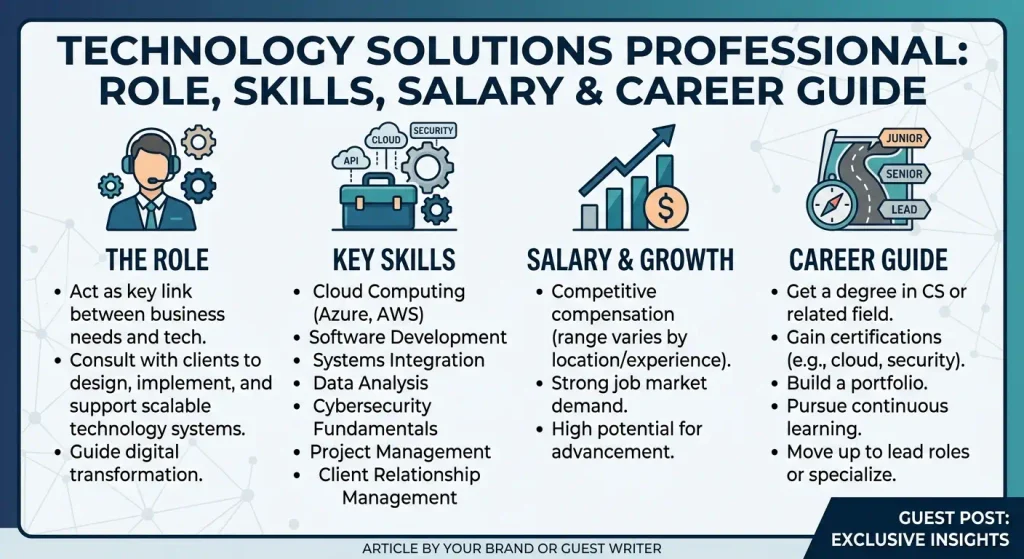
- Cloud computing (AWS, Microsoft Azure, Google Cloud)
- Networking and infrastructure fundamentals
- Cybersecurity basics and risk assessment
- Software configuration and systems integration
- Working knowledge of APIs and databases
- Data analytics and reporting tools
- Familiarity with artificial intelligence tools now common in business workflows
Business and communication skills
- Business analysis and requirements gathering
- Project management and timeline coordination
- Client-facing communication that turns technical detail into plain language
- Documentation and proposal writing
- Critical thinking under ambiguity
A technology solutions professional doesn’t need to be the deepest technical expert on a team. The real value comes from two things. First, being technical enough to judge options fairly. Second, being business-savvy enough to know which option actually fits the client’s problem.
Employers often describe this as a “T-shaped” skill set. That means broad knowledge across cloud, security, data, and integration topics. It also means enough depth in one area to lead decisions, not just relay them. Candidates from one narrow background, like only networking, often need to build the business side of this skill set on purpose. Otherwise, they won’t be competitive for this title.
Technology Solutions Professional Salary in the USA
Salary is one of the most searched parts of this role. So it deserves accurate, sourced data, not a rounded estimate copied from an unrelated blog.
According to Indeed’s U.S. salary data for this exact job title, the average reported base salary is $93,654 per year. This figure was updated September 6, 2026. It’s based on 276 salaries from job postings over the prior 36 months. The same dataset shows a range of roughly $47,858 to $183,274 per year. That wide range shows how much location, employer, and specialization affect pay for a technology solutions professional.
Indeed’s data also lists a few higher-paying U.S. metro areas for this title. These include Washington, D.C., Atlanta, and Huntsville. Washington, D.C. reports figures around $148,852 per year, well above the national average.
What Affects Salary
- Experience level — entry-level roles sit closer to the lower end; senior or lead roles trend higher
- Location — major tech and government hubs usually report higher averages
- Employer type — large technology vendors, consulting firms, and government contractors often pay differently than smaller firms
- Specialization — cybersecurity, cloud, and AI-focused roles often command a premium
- Industry — finance, healthcare, and government technology roles can pay quite differently from general commercial roles
One thing is worth saying directly. No single number represents what every technology solutions professional earns. Treat the Indeed figure as a current market reference point, not a guarantee.
What Qualifications Do You Need?
Most employers list a bachelor’s degree as a baseline. However, the field of study varies. Common options include:
- Computer science
- Information technology or information systems
- Business technology or management information systems
- Engineering disciplines with a technology focus
Qualification requirements vary a lot by employer and specialization, though. Some organizations care more about demonstrated project experience and certifications than a specific degree. This is especially true for candidates moving from adjacent IT roles, like systems administration or technical support.
Certifications For Technology Solutions Professionals
Certifications aren’t required everywhere. But they can strengthen a candidate’s profile in a specific specialization. Common categories include:
- Cloud certifications — associate- or professional-level credentials from AWS, Microsoft Azure, or Google Cloud
- Cybersecurity certifications — foundational credentials tied to risk assessment and compliance
- Networking certifications — infrastructure and systems-level credentials
- Solution architecture certifications — useful for professionals moving toward architecture-heavy work
- Project management certifications — relevant given how much of the role involves coordinating implementation
No single certification is mandatory across the board. The right one depends on the specialization a candidate is targeting, whether that’s cloud, security, data, or infrastructure. Here’s a simple rule: pick a certification that matches a specialization already mentioned in job postings you want. Don’t just collect broad, unrelated credentials. One well-chosen certification tied to real project experience usually carries more weight than several generic ones.
Technology Solutions Professional Career Path
There isn’t one universal ladder for this role. But a common, illustrative path looks like this:
Entry-level IT or technical support → Systems administrator or technical specialist → Consultant or solutions engineer → Technology Solutions Professional → Senior or lead technology consultant
Professionals often move into this title from adjacent roles. These include IT consulting, systems analysis, or cloud engineering. The shift usually happens once they’ve built enough experience managing both the technical and business sides of a project.
Technology Solutions Professional vs. Solutions Architect
These titles overlap. That overlap causes confusion during job searches. Here’s how they generally differ:
| Area | Technology Solutions Professional | Solutions Architect |
| Main focus | Business needs plus technology solutions | Technical architecture and system design |
| Customer interaction | Often significant and ongoing | Varies by employer |
| Business analysis | Strong emphasis | Present, but secondary to architecture |
| Architecture depth | Sometimes involved | Core responsibility |
| Implementation role | May participate directly | Usually guides technical direction |
| Overall scope | Broader, more business-facing | Narrower, more architecture-focused |
Not every company uses these titles the same way. Some use them interchangeably. Job seekers should read the actual responsibilities in a posting. Don’t assume the title alone defines the scope.
Technology Solutions Professional vs. IT Consultant
These two roles also overlap. Still, a few useful distinctions stand out:
| Area | Technology Solutions Professional | IT Consultant |
| Employment structure | Often in-house or with a technology vendor | Frequently works across multiple clients |
| Technical depth | Broad, cross-functional | Can be broad or highly specialized |
| Business analysis | Core part of the role | Also core, especially for strategy work |
| Implementation | Frequently hands-on | Ranges from advisory-only to hands-on |
| Client relationship | Often long-term, single organization | Often project-based, multiple clients |
What Technologies Do They Work With?
A technology solutions professional typically works with a recognizable set of enterprise technologies:
- Cloud platforms — AWS, Microsoft Azure, Google Cloud
- Cybersecurity tools and frameworks
- APIs and system integration platforms
- Databases and data warehousing tools
- Enterprise software, like CRM and ERP systems
- Networking and infrastructure tools
- Automation and workflow platforms
- Data analytics and business intelligence tools
Why Businesses Use Technology Solutions, Professionals
Companies bring in a technology solutions professional for a specific reason. They have a business problem with a technology component, and they lack the in-house expertise to solve it cleanly. A few common scenarios:
Cloud migration. A business running aging on-premises servers needs to move workloads to the cloud without disrupting operations.
Cybersecurity improvement. A growing company with rising cyber risk needs an assessment, a roadmap, and help putting stronger controls in place.
Software integration. A company using disconnected tools, like a CRM that doesn’t talk to its analytics platform, needs those systems unified.
Data modernization. A business with years of siloed data wants to consolidate it into one usable analytics or reporting system.
AI implementation. A company wants to apply artificial intelligence tools to a specific workflow. But it needs help scoping what’s realistic versus what’s hype.
A real-world scenario. Picture a mid-sized e-commerce company. Its CRM doesn’t sync with its analytics platform. It also has cybersecurity gaps left over from rapid early growth. A technology solutions professional wouldn’t just recommend new software here. First, they’d map out how the CRM, analytics, and security tools should interact. Next, they’d prioritize which gap poses the most immediate business risk. Then they’d coordinate the technical teams or vendors who implement each piece. The technology choices come second. The business diagnosis always comes first.
Technology Solutions Professional in 2026
A few shifts are visibly changing what employers expect from this role in 2026:
- AI integration — more postings now expect comfort applying AI tools to real workflows, not just understanding them in theory
- Cloud modernization — the steady move away from legacy on-premises infrastructure keeps driving demand
- Cybersecurity pressure — rising cyber risk has made security fluency a baseline skill, not a specialty
- Systems integration complexity — businesses run more disconnected tools than ever, so demand keeps growing for professionals who can unify them
- Data-driven decisions — more roles now expect comfort with analytics platforms, not just infrastructure
These shifts don’t change the fundamentals of the role. They simply expand the technology stack a technology solutions professional needs to stay fluent in.
How To Become A Technology Solutions Professional
Here’s a practical roadmap for entering the field:
- Learn IT fundamentals — networking, systems, and basic software concepts
- Choose a specialization — cloud, cybersecurity, data, or integration
- Gain hands-on experience — through an entry-level IT, support, or junior technical role
- Build business-analysis skills — requirements gathering, documentation, and stakeholder communication
- Develop cloud and security fundamentals — baseline fluency matters, even outside your core specialization
- Build real projects — a portfolio of solved problems persuades more than a resume line
- Pursue relevant certifications — matched to your specialization, not chosen for their own sake
- Apply with specific examples — be ready to describe a real business problem you helped solve
Conclusion
A technology solutions professional occupies a genuinely useful middle ground. They’re technical enough to evaluate real solutions. They’re business-savvy enough to know which one actually fits. Whether you’re researching this as a career path or wondering if your business needs this expertise, the role comes down to one thing: connecting a real problem to a technology that actually solves it, not just the newest one available.
Planning a career in technology? Explore related guides on cloud computing, cybersecurity for small businesses, and AI in business to keep building your technical foundation.
Need help evaluating your company’s technology setup? A professional technology assessment can help identify security gaps, integration issues, and scalability risks before they turn into expensive problems.
Visit the USABusinessDaily for more career guides and business technology coverage.
Frequently Asked Questions
What is a technology solutions professional?
A technology solutions professional identifies a business’s technology needs. Then they help design, select, and implement the solution that meets them, working across both technical and business teams.
What does a technology solutions professional do?
The role involves gathering business requirements, assessing existing systems, and designing and evaluating solutions. It also includes coordinating implementation and communicating with stakeholders throughout.
How much does a technology solutions professional make in the USA?
According to Indeed’s U.S. data updated September 6, 2026, the average reported base salary is $93,654 per year. The reported range runs roughly $47,858 to $183,274, depending on experience, location, and specialization.
What skills are needed to become a technology solutions professional?
You’ll need a mix of technical skills (cloud, networking, cybersecurity, data) and business skills (communication, project management, requirements gathering). See the skills section above for the full breakdown.
What degree do you need for this career?
Most employers prefer a bachelor’s degree in computer science, information technology, or a related field. That said, requirements vary, and relevant experience can substitute in some cases.
What certifications are useful?
Cloud, cybersecurity, networking, and project-management certifications are the most commonly relevant, depending on your chosen specialization.
Is a technology solutions professional the same as a solutions architect?
Not exactly. A technology solutions professional usually has a broader, more business-facing scope. A solutions architect focuses more on technical architecture. That said, some companies use the titles interchangeably.
What technologies do technology solutions professionals use?
Common tools include cloud platforms like AWS, Azure, and Google Cloud, plus cybersecurity tools, APIs, databases, enterprise software, and data analytics platforms.
Where do technology solutions professionals work?
They work across industries, including technology vendors, consulting firms, financial services, healthcare, and government. Wherever businesses need technology aligned to specific goals, this role fits.
How can I become a technology solutions professional?
Build IT fundamentals, choose a specialization, and gain hands-on experience. Then develop business-analysis skills and pursue certifications relevant to your focus area. See the roadmap above for the full step-by-step path.