How to Frame Your Educational Background in Bank Interviews (Arts, Science, Tech)
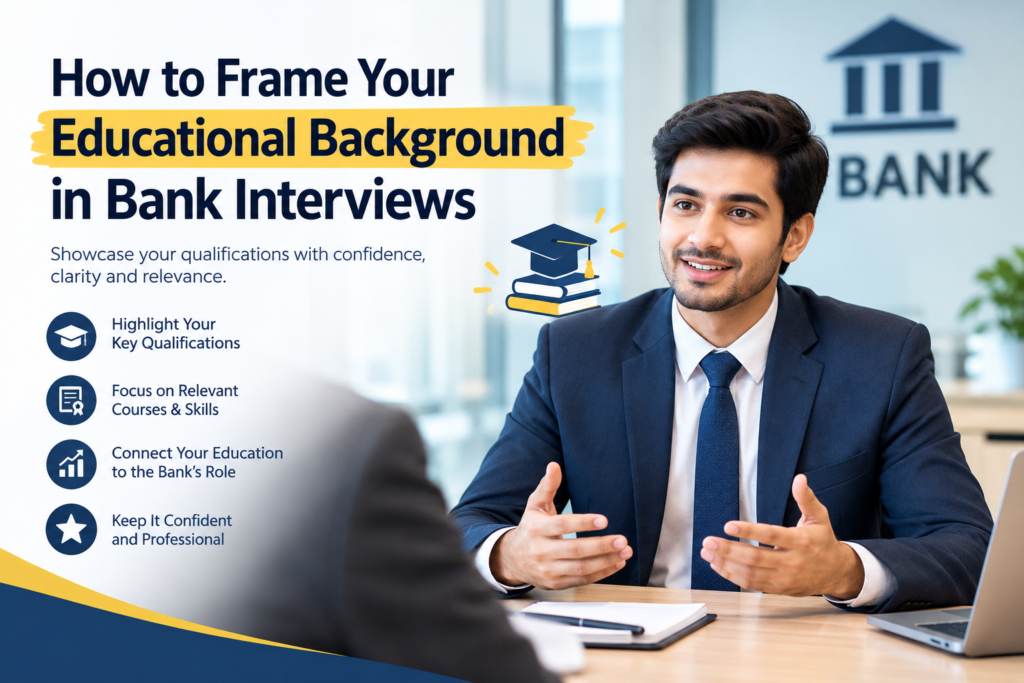
The most common yet important part of a Bank PO or Specialist Officer interview process occurs when the panel discusses the educational background of the candidate. Many students who come from a non-finance background, such as Humanities, Pure Sciences, and Engineering, often think about how their academic background would be considered inappropriate for a banking career.
But the truth is that both government and private banks always look for candidates with different backgrounds due to their varied duties and operations. It is important for candidates to focus on how their academic background becomes an added advantage rather than defending it. Here is how students from Arts, Science, and Technology can do so.
Candidates could opt for bank coaching that will help them know how to portray their education in an effective manner by relating their educational knowledge with banking skills.
How to frame your educational background in bank interviews(arts, science, tech)
Read the following pointers to learn how to frame your educational background in bank interviews from arts, science and tech:
- The arts & humanities graduate: emphasizing communication, ethics, and public relations
Art graduates are always in doubt about how the history, politics, literature, sociology, and other subjects they studied by them have relevance in banking transactions. The relevance is in terms of soft skills, stakeholder management, and critical thinking.
Top Skills That Must Be Mentioned:
- Empathy/Relationship with Customers: The banking industry demands a relationship with its customers. Tell me how the information you have gained from social sciences will assist you in understanding the customer.
- Documentation/Analysis: Today’s banking requires lots of documentation and communication. Talk about your skills in writing and analyzing information.
- Public Policy/Economics: If you have any knowledge in economics/political science/public administration, then talk about governmental policies and economics.
- The science graduate: highlighting data precision, logic, and problem-solving
While some candidates with degrees in Physics, Chemistry, Mathematics, and Life Sciences find it difficult to cope with financial terminology, the whole process of scientific research is a key aspect of finance itself.
Strengths to Emphasize:
- Numerical and analytical abilities: The graduates of Mathematics, Statistics, and Physics may take pride in their numerical ability, which will come in handy for risk analysis and auditing.
- Attention to detail and accuracy: Courses in sciences demand precision both in lab work and when solving problems. This can be described as a means of avoiding mistakes in terms of administration, accountancy, and regulation.
- Research & Structured Problem-Solving: How has the study of science taught you to take a scientific approach to solving operational problems?
- The tech & engineering graduate: driving digital banking and process efficiency
B.Tech/B.E. and BCA/MCA students can be expected to face questions like, “Why banking after engineering?” Instead of looking at your engineering degree as a detour, look at it as an advantage when everything is dominated by FinTech, Core Banking Solutions (CBS), and digital payments.
Key Points to Highlight:
- Versatility in Banking Technology: The modern bank runs on technology. Look at your background in technology as an advantage to easily adapt to CBS technology, cybersecurity, and digital payment technology.
- Process optimization: The discipline of engineering deals with process optimization. Tie it to the efficiency in running branch operations, turnaround time optimization (TAT), etc.
- Data processing/automation: Talk about how your understanding of data structures/logic/data analytics gives insight into data-driven decisions in banks.
Things to consider for job Interview preparation
Prepare a Perfect Introduction
If you want to impress the interviewers immediately, make sure to prepare a perfect introduction. Let us tell you that preparing a unique introduction is the best way to improve your scores and have a good impression on the interviewees.
Research Well
You need to research well about the job role you have applied for. Know the roles and responsibilities by doing extensive research. Prepare an answer for how you will manage the responsibilities if you get the job. Know the skills required to do this job. Then, try to prove that you have all the skills and abilities to handle all the job responsibilities after getting that particular job.
Boost Your Confidence
The interview is such a phase where almost everyone gets nervous. However, this nervousness hampers your concentration and never lets you think about the answers critically. Therefore, it is necessary to boost your confidence before you appear for the interview. Well, confidence can be boosted with better preparation and regular practice. So, it is better to give mock interviews every day or twice a week to take your confidence to the next level.
The candidates can also look at the guidance provided by SSC coaching to help them hone their communication skills and effectively portray their education.
Conclusion
It is not a necessary condition for all candidates to have a degree in Commerce or Finance, as the interviewers judge your ability to think clearly, be flexible, and be aware of yourself. Whether your specialization belongs to the field of Arts, Science, or technology, the formula for presenting your academic profile lies in matching your present skills with the functions of a banker. Your ability to communicate, analyze logically, be precise, or be technically knowledgeable would definitely help you present your unique profile.