How Future Healthcare Technology Is Transforming Home Care in 2026
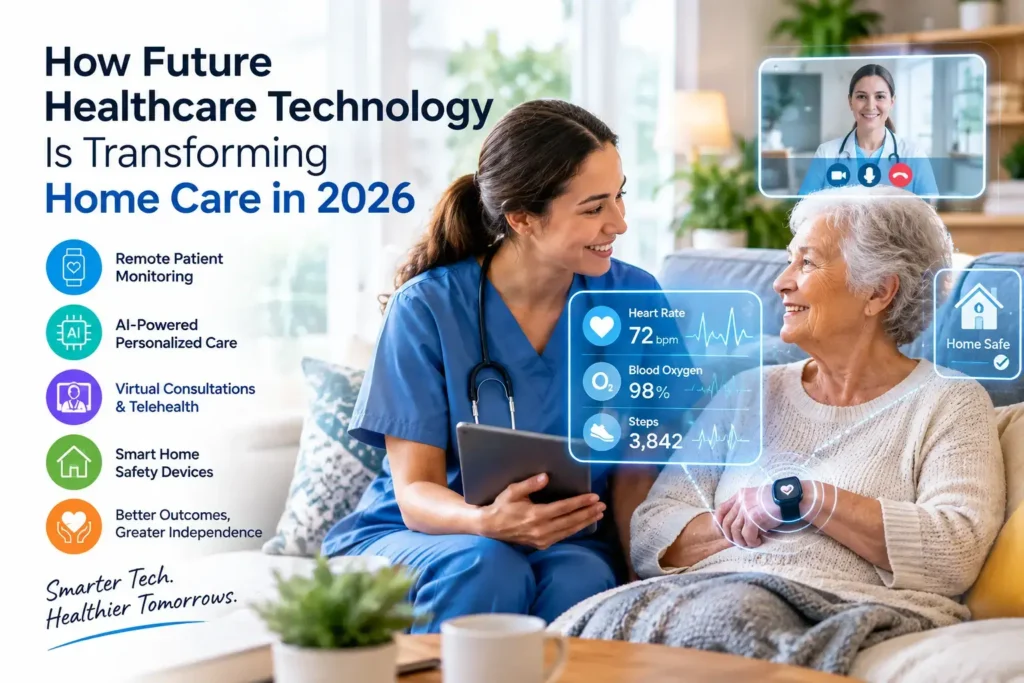
The future of healthcare technology in home care is already here. A blood pressure cuff in a kitchen now sends readings to a clinic. A tablet now connects a patient with a nurse in minutes. A motion sensor can alert a daughter if her father’s morning routine changes.
At UsaBusinessDaily, we looked at the evidence behind these tools. This guide explains what works today, what is still experimental, what it costs, and how to choose wisely.
How Is Technology Changing Home Healthcare?
Technology is changing home healthcare by moving monitoring, communication, and care coordination from clinics into the home. Devices collect health data, software helps clinicians review it, and video visits replace some travel. These tools support care. They do not replace professional judgment or hands-on help.
Two trends are driving this shift. First, America is aging. The National Center for Health Statistics projects that Americans aged 85 and older will grow from 6.1 million in 2023 to 13.7 million by 2040, according to the CDC. Second, chronic illness is common in that group. The same CDC report found hypertension in 66.9% of noninstitutionalized adults aged 85 and older in 2022–2023.
Families are already adapting. A February 2026 survey by NORC at the University of Chicago found that 48% of unpaid caregivers use at least one type of technology to support their care. Use was higher among caregivers over 45 (58%) than among those aged 18 to 44 (35%). The survey also found that more than half of caregivers report barriers to using digital tools.
These numbers show demand. They do not prove that any single device improves outcomes. That depends on the tool, the patient, and the care team behind it.
What Is Healthcare Technology in Home Care?
Home healthcare technology includes digital tools, medical devices, software, and connected systems that help people receive or manage care at home. Examples include telehealth platforms, remote monitoring devices, medication reminders, and smart safety sensors.
These tools fall into five groups:
- Artificial intelligence (AI) and predictive analytics
- Remote patient monitoring (RPM) and wearable sensors
- Smart-home safety systems and emergency alerts
- Telehealth and virtual consultations
- Medication management and caregiver coordination apps
Underneath them sits shared infrastructure. Electronic health records (EHRs) store patient data. Standards such as HL7 FHIR help different systems exchange it. Without that connection, a device reading may never reach the right clinician.
How AI Is Improving Home Healthcare
AI in home healthcare can help clinicians review monitoring data, spot patterns that may need attention, and reduce selected administrative work. Its value depends on data quality, clinical oversight, and how well it fits existing workflows. AI does not diagnose conditions on its own.
Here is where AI is most practical:
- Predictive analytics: Software can flag a gradual rise in resting heart rate or a drop in daily activity. A nurse then decides whether to call the patient.
- Documentation support: Tools can draft visit notes, which may free clinicians for patient contact.
- Scheduling and matching: Agencies can use AI to match caregivers with patients and plan routes.
- Voice assistants: Older adults can set reminders or call family with spoken commands.
Be careful with bold claims here. Some AI features are in daily use. Others are still in pilots or research. Ask any vendor which category its product falls into, and ask who reviews the alerts. For a wider look at the technology, read our guide on how AI is changing healthcare. You can also explore AI and the future of patient care for clinical applications.
Remote Patient Monitoring and Wearable Devices
Remote patient monitoring is the collection and transmission of patient health data from outside a clinic so professionals can review it and make care decisions. The patient measures a vital sign at home. The device sends it securely. A care team reviews it and follows up when needed.
Common devices include:
- Blood pressure monitors
- Pulse oximeters, which measure blood oxygen
- Continuous glucose monitors for diabetes
- Smart scales for heart-failure patients
- Wearable sensors that track heart rhythm or activity
The IEEE AgeTech overview describes how RPM measures indicators such as blood pressure, glucose, oxygen saturation, and heart rhythm. Our remote patient monitoring explained guide covers the workflow in more detail.
One point matters more than any feature. Data is not care. A device that records a reading does not guarantee a clinician sees it right away. Before you enroll, ask who reviews readings, how often, and what happens after hours.
How Remote Monitoring Works: Four Steps
- Device: The patient takes a reading at home.
- Secure transfer: The device sends data over Wi-Fi, Bluetooth, or cellular.
- Clinical review: A nurse or physician checks the data against care goals.
- Follow-up: The team calls, adjusts treatment, or schedules a visit when appropriate.
Smart Homes, Fall Detection, and Aging in Place
Technology for aging in place helps older adults stay in their own homes safely. The National Institute on Aging stresses that aging in place also needs planning for safety, mobility, and support. Technology is only one part of that plan.
Useful tools include:
- Fall detection: Wearables or room sensors that detect a fall and alert contacts
- Emergency alert systems: Pendants or wrist devices with a call button
- Motion sensors: Systems that learn routines and flag unusual changes, often without cameras
- Smart lighting and door sensors: Features that reduce nighttime risk
Researchers are studying how digital tools can extend independent living. A 2026 perspective in the Journal of Medical Internet Research explores wearables, monitoring systems, and smart-home tools in that context. Dignity matters here too. Many seniors accept a motion sensor more readily than a camera, so involve them in the choice. For product ideas, see smart-home technology for seniors.
Telehealth and Virtual Care at Home
Telehealth for home healthcare lets patients see clinicians by video or phone without traveling. It helps most with follow-up visits, medication reviews, mental health care, and chronic-condition check-ins. It helps rural households and people with limited mobility the most.
Telehealth has limits. Some conditions need an in-person exam. Rural homes may lack reliable broadband. Some older adults need help setting up the first call. For a deeper look, read about telehealth services in the USA.
Many families also use patient portals. These secure websites let you message your care team, view results, and request refills.
Smart Medication Management and Caregiver Support
Missed doses are a common problem at home. Technology can help in three ways:
- Reminder apps send alerts to a phone or tablet.
- Connected dispensers release the right pills at set times and notify a caregiver if a dose is missed.
- Shared care apps let siblings or aides see the same schedule and notes.
In the NORC survey, caregivers reported using tools such as reminders and remote monitoring. Even so, more than half reported barriers to using technology. Cost, complexity, and privacy worries are common reasons.
An Illustrative Scenario
This example is fictional and is included only to show how the tools can work together.
Imagine a 78-year-old man with high blood pressure who lives alone. His doctor orders a connected cuff. He takes a reading each morning. A pill dispenser reminds him of his medicines. If he misses a dose, his daughter gets a text. When his readings stay high for several days, a nurse calls him and arranges a video visit. The technology did not treat him. It helped people notice a problem sooner.
How Connected Systems Share Patient Data
Interoperability means different health systems can exchange and use data. It matters because a home device is only useful if its data reaches the patient’s record. HL7 FHIR is a widely used standard that helps systems share information through application programming interfaces (APIs).
The federal health IT office tracks this progress. Its data brief on hospital API use explains how hospitals use APIs to link EHRs with third-party tools. For families, the practical question is simple: will this device share data with my doctor’s system, or will I have to copy numbers by hand?
Benefits for Patients, Families, and Providers
| Group | Possible benefits | Limits to keep in mind |
| Patients | More independence, fewer trips, earlier attention to changes | May feel intrusive; needs comfort with devices |
| Family caregivers | Shared schedules, reminders, alerts | Alerts can add stress or false alarms |
| Home health agencies | Better coordination, less paperwork | Integration costs; staff training |
| Rural households | Easier access to specialists | Depends on internet quality |
Benefits depend on fit. A tool that suits one patient may overwhelm another.
Costs, Medicare Coverage, Privacy, and Limitations
What Does Home Healthcare Technology Cost?
There is no single price. Home healthcare technology costs depend on the device, the service, and who pays. Check these components before you buy:
| Cost component | What to ask |
| Upfront device or installation | Is the device sold, leased, or supplied by a clinic? |
| Monthly subscription | What does the fee include? |
| Connectivity | Does it need Wi-Fi, a cellular plan, or both? |
| Batteries and maintenance | Who replaces parts and how often? |
| Professional monitoring | Is clinical review included or billed separately? |
| Insurance | What are the deductibles and copayments? |
Only trust a price once you know what it covers.
Does Medicare Cover Home Healthcare Technology?
Coverage depends on the service. Medicare may cover certain telehealth and home health services. That does not mean it covers every smart device, subscription, or nonmedical caregiving service.
Telehealth. Congress passed the Consolidated Appropriations Act, 2026, and it was signed into law on February 3, 2026. It extends key Medicare telehealth flexibilities through December 31, 2027. Audio-only telehealth also remains permitted through that date. After that, CMS has indicated that policies will largely revert to pre-pandemic rules unless Congress acts again. Always confirm current rules on Medicare.gov telehealth coverage.
Remote patient monitoring. RPM is covered under Medicare Part B, so patients are generally responsible for 20% coinsurance. Billing sources also describe requirements such as a doctor’s order, patient consent, and devices that upload data automatically. Medigap or Medicaid may help with the coinsurance. Medicare Advantage plans can differ, so call your plan.
Home health services. This is a separate benefit with its own eligibility rules. It generally requires that you be homebound and need skilled care ordered by a doctor. Read the official Medicare home health coverage page before assuming you qualify.
Hospital at home. The Acute Hospital Care at Home initiative was extended through September 30, 2030.
Is Home Health Monitoring Safe and Private?
Privacy depends on who runs the service. HIPAA, the federal health privacy law, applies to many healthcare providers and their business partners. Consumer apps and devices are not automatically covered. See the HHS HIPAA overview for how the rule applies.
Protect your data with these steps:
- Read what the app collects and who can see it.
- Use strong, unique passwords and turn on two-factor authentication.
- Update device software when prompted.
- Share data only with people who need it.
- Ask whether data is encrypted in transit and at rest.
What Are the Risks and Limitations?
Healthcare technology risks are real, and they deserve plain language:
- False alerts: Too many alarms can cause alert fatigue.
- Connectivity failures: A dead battery or lost signal can stop monitoring.
- Digital literacy gaps: A tool nobody can use does not help.
- Overreliance: Automation should not replace check-ins and human contact.
- Privacy exposure: Connected devices create more data to protect.
Future Home Healthcare Trends Beyond 2026
The following are directions to watch. They are informed expectations, not guarantees.
- Hybrid care: Samsung’s 2026 analysis of the connected home describes the home as a care platform that blends monitoring, AI, and virtual visits.
- Ambient sensing: Room sensors may track movement and routines without wearables or cameras.
- Hospital-level care at home: The extended federal initiative may encourage more programs.
- Better data exchange: Wider API use may reduce manual entry.
- Policy decisions: The end of 2027 is a key date for Medicare telehealth rules.
For wider context, see our coverage of emerging healthcare technology trends.
What the Future Means for Patients
Patients may gain easier access, more independence, and earlier attention to changes. Affordability and human support will still decide who benefits. Technology works best when it adds to human care.
How to Choose the Right Home Healthcare Technology
Use this checklist before you buy or enroll:
- Talk to a clinician first. Ask what needs monitoring and why.
- Match the tool to the problem. Falls, medication, and blood pressure need different tools.
- Test ease of use. The patient should operate it without constant help.
- Check compatibility. Confirm it works with your phone, internet, and care team’s system.
- Confirm who responds. Ask who receives alerts and when.
- Review the full cost. Include subscriptions, connectivity, and replacement parts.
- Verify insurance. Ask Medicare, your plan, or Medicaid what applies.
- Read the privacy policy. Know what is collected and shared.
- Plan for outages. Keep a backup contact method.
- Get consent. Involve the older adult in every decision.
Frequently Asked Questions
What is the future of healthcare technology in home care?
It is a shift toward connected, clinician-supervised care at home. Expect more remote monitoring, virtual visits, AI-assisted workflows, and shared data. Results will depend on cost, privacy, access, and human support.
How is artificial intelligence changing home healthcare?
AI helps clinicians review monitoring data, flag patterns, and handle some paperwork. It supports decisions rather than making them. Quality depends on the data and on human oversight.
What are the latest home healthcare technology trends in 2026?
Key trends include hybrid care, ambient sensors, wider remote monitoring, AI-assisted documentation, and better data exchange. Medicare telehealth rules and hospital-at-home policy are also shaping adoption.
How does remote patient monitoring work?
A home device records a vital sign and sends it securely to a care team. A clinician reviews the data and follows up if needed. Monitoring is not always continuous, so ask how alerts are handled.
What technologies help seniors age in place?
Helpful tools include medication reminders, emergency alert pendants, fall detection, motion sensors, video calling, and telehealth. They work best alongside home safety changes and personal support, as the National Institute on Aging advises.
Can smart-home devices help prevent falls?
Some devices detect falls and call for help quickly. Lighting and sensors may reduce risk. Evidence varies by device, so ask for clinical validation and combine tools with physical home safety changes.
What are the benefits of telehealth for home care?
Telehealth saves travel, widens access to specialists, and supports follow-up care. It helps people with limited mobility or rural homes. It cannot replace every in-person exam.
How much does home healthcare technology cost?
Costs vary widely. Consider device fees, subscriptions, connectivity, maintenance, and professional monitoring. Insurance may cover some services but not every device, so verify before you buy.
Does Medicare cover remote patient monitoring and telehealth?
Medicare may cover both under certain conditions. Telehealth flexibilities run through December 31, 2027. RPM under Part B typically carries 20% coinsurance. Check Medicare.gov or your plan for current rules.
What are the risks of using AI in healthcare at home?
Risks include inaccurate outputs, biased data, false alerts, and privacy exposure. Choose tools with clinician oversight, and treat AI suggestions as input for a professional to review.
How can families protect health data from connected devices?
Use strong passwords, two-factor authentication, and software updates. Limit who can see the data. Read privacy policies, and do not assume a consumer app falls under HIPAA.
Will technology replace home healthcare workers?
No evidence supports full replacement. Technology can reduce routine tasks and improve coordination. Hands-on care, judgment, and human connection still require people.
Conclusion
The future of healthcare technology in home care is practical, not magical. Tools such as remote monitoring, telehealth, smart sensors, and AI can support safety and independence. They work best when matched to real needs and backed by a responsive care team.
Start with your needs, budget, privacy preferences, and available support. Talk to a qualified healthcare professional about what to monitor. Then compare options and confirm coverage. USABusinessDaily will keep tracking this field, so explore our related guides and subscribe for practical updates on healthcare innovation.