Cigarette Size Chart And Packaging Guide That Every Brand Needs to Know

A cigarette size chart lists the common cigarette formats by length and width. Regular cigarettes run about 70–75 mm. King-size cigarettes run about 84–85 mm. The 100s format runs about 98–100 mm, and 120s run about 120 mm. These are reference figures. Exact numbers change by product and manufacturer.
At USABusinessDaily, we see one mistake again and again. Teams mix up the size of the cigarette with the size of the pack. They are two different measurements. A wrong guess leads to a box that does not fit, a delayed prototype, or a costly reprint.
This guide separates the two. You will get a clear chart, a pack comparison, a measuring method, and a pre-order checklist.
Cigarette Size Chart: Standard Dimensions at a Glance
| Format | Approx. length (mm) | Approx. length (in) | Packaging note |
| Regular | 70–75 | 2.76–2.95 | Shortest internal pack length |
| King-size | 84–85 | 3.31–3.35 | Most common pack format |
| 100s | 98–100 | 3.86–3.94 | Needs extra internal length |
| 120s | About 120 | About 4.72 | Needs a longer, custom pack |
| Slim / Super-slim | Varies | Varies | Narrower diameter changes the layout |
These are approximate reference ranges, not universal manufacturing specifications. Confirm dimensions for your exact product before production.
Regular Cigarettes
Regular cigarettes are the shortest common format. They sit at roughly 70–75 mm. They need the least internal pack length of any format in the chart.
King-Size Cigarettes
King-size cigarettes are around 84–85 mm long. This is the standard reference point for most cigarette sizes and for many cigarette pack dimensions you will find quoted online.
100s Cigarettes
The 100s cigarette dimensions sit near 98–100 mm in length. That extra length means a taller or longer pack. You cannot simply reuse a king-size box.
120s Cigarettes
The 120s format is about 120 mm. It is less common in the US, so packaging for it is usually built to order.
Slim and Super-Slim Cigarettes
Slim formats change the diameter, not just the length. A narrower cigarette changes how many sticks fit across a row. That changes the pack width.
Cigarette Length vs. Diameter
Length is the distance from the tip to the filter end. Diameter is the width of the cigarette’s round body. Circumference is the distance around it.
For packaging, length sets the internal height of the pack. Diameter and stick count set its width and depth. Measure both on your actual product. Do not rely on a generic chart for either.
Cigarette Pack Dimensions Chart
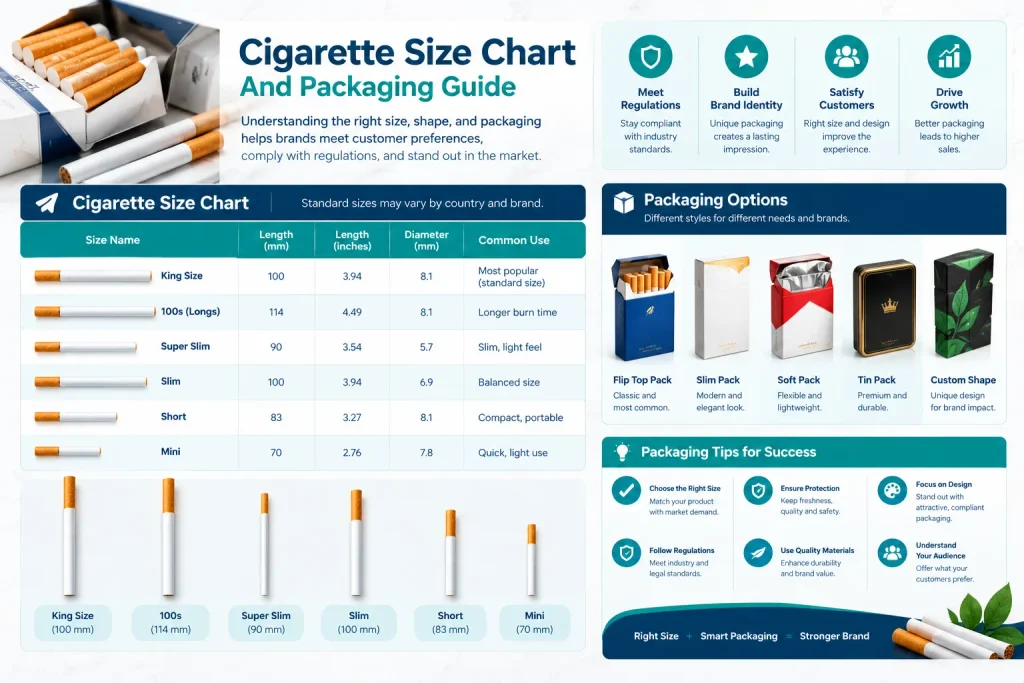
A commonly cited reference for a 20-count king-size pack is about 85 × 55 × 22 mm (length × width × depth). Treat this as a reference point, not a standard.
Two sets of numbers matter:
- Internal dimensions: the space inside the pack that holds the product.
- External dimensions: the full size of the finished pack, including board thickness and closure.
Mixing these up is the top cause of fit problems. Always label which one you mean in a spec sheet.
King-Size vs. 100s Cigarettes: What’s the Difference?
King-size cigarettes are generally around 84–85 mm. The 100s format is around 98–100 mm. The gap is roughly 14 mm.
| Feature | King-size | 100s |
| Approx. length | 84–85 mm | 98–100 mm |
| Pack length need | Standard | Longer |
| Reusable king-size box? | Yes | No |
The main takeaway: a 100s product needs its own box specification. Verify it against a real sample.
Common Cigarette Packaging Types
Hard Packs
A hard pack, often called a flip-top box, uses a rigid folding carton. It holds its shape well and has a hinged lid.
Soft Packs
A soft pack uses flexible wrapping material. It is lighter, but its final size depends heavily on how it is filled and sealed.
Cigarette Cartons
A common US carton holds 10 packs of 20 cigarettes, or 200 cigarettes in total. Cigarette carton dimensions depend on how the packs are arranged and on board thickness. Confirm the configuration for your product.
How to Measure Cigarette Box Dimensions
Use a caliper or a rigid ruler with millimeter marks. Follow these steps:
- Measure the cigarette’s length and diameter.
- Count the cigarettes in the pack.
- Measure the finished pack’s external length, width and depth.
- Open the pack and record the internal length, width and depth.
- Note the board thickness and the closure style.
- Record every figure in both millimeters and inches.
- Test the result against a physical sample.
This process works for a cigarette box dimensions check and for a dieline brief. A dieline is the flat template used to cut and fold the box.
What Affects Cigarette Packaging Dimensions?
Several factors change the final size:
- Product size: cigarette length and diameter.
- Pack count and layout: how sticks are arranged.
- Material: thicker board adds to external size.
- Liner and closure: foil liners and hinges take up space.
- Manufacturing tolerance: small, allowed variations in cutting and folding.
This is why two suppliers can report different numbers for what looks like the same pack. Read our guide to packaging materials for more on how board choice shapes finished size.
Cigarette Packaging Requirements in the USA
Cigarette packaging in the US must follow federal labeling rules. The U.S. Food and Drug Administration (FDA) publishes the official guidance on cigarette labeling and warning statement requirements.
Health warning rules have been affected by court action. The status of the graphic-warning rule can change. Check the FDA page before you finalize artwork, and have a qualified compliance professional review your design.
The size ranges in this guide are not regulatory standards. They describe typical products only. For national smoking data, see the CDC’s smoking FastStats page.
What to Check Before Ordering Custom Cigarette Packaging
Before you contact a supplier, confirm:
- Exact product length and diameter
- Pack count per box
- Box style and closure type
- Material and board thickness
- Internal and external dimensions
- Artwork and required labeling
- Prototype approval steps
- Production tolerances
- Quality-control checks
If you plan custom cigarette packaging, send this list with your request. It cuts back-and-forth and speeds up quoting. For measurement help, see our notes on custom box dimensions and packaging design specifications. Good packaging quality control starts with an approved sample.
Frequently Asked Questions
What are the standard cigarette sizes?
Common formats are regular, king-size, 100s and 120s. Exact dimensions vary by manufacturer.
How long is a king-size cigarette?
About 84–85 mm, depending on the product.
How long is a 100s cigarette?
About 98–100 mm. Verify packaging against the actual product.
What is the difference between king-size and 100s cigarettes?
Length. The 100s format is longer and needs more internal pack space.
What are the dimensions of a standard cigarette pack?
A common reference for a 20-count king-size pack is about 85 × 55 × 22 mm. Actual sizes vary.
How many cigarettes are in a standard US carton?
A common carton holds 10 packs of 20, or 200 cigarettes. Confirm for your product.
Are cigarette pack dimensions the same for every brand?
No. Format, construction, material thickness, and tolerances all change the result.
What is the difference between a hard pack and a soft pack?
A hard pack has a rigid outer structure. A soft pack uses flexible material. Final dimensions depend on the design.
How do you measure cigarette box dimensions?
Measure external and internal length, width, and depth. Add board thickness and closure details.
What should businesses check before ordering custom cigarette packaging?
Product dimensions, pack count, box style, material, tolerances, artwork, labeling, and prototype approval.
Conclusion
A reliable cigarette size chart is only the first step. The pack is a separate measurement, and it depends on board, closure, and tolerance. Measure your real product, label every figure as internal or external, and approve a physical sample before production.
If you have verified your specifications, discuss your packaging specifications with a qualified supplier. For more practical guides, explore custom packaging solutions on USABusinessDaily.