
How Healthcare Apps Are Improving Patient Engagement and Care Coordination
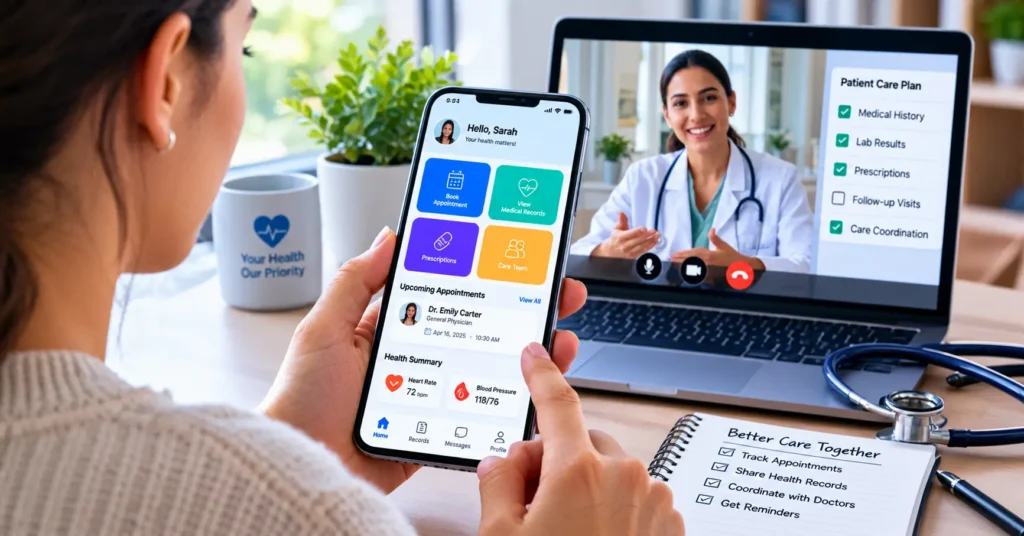
Bus driver Walter Brennan, 68, of Ohio, came out of the hospital with a folder of discharge papers and not just a bag of new prescriptions, but a commitment to follow up his heart failure scare. At least not in the spur of the moment. 1 week later his heart began to make him breathe shortness and he couldn’t bring himself to call his cardiologist or primary care physician. He was automatically seen daily by his health system and was reminded to take his medicine, and he had a ‘nurse care coordinator’ (Denise) who he had direct access to. If he put on two pounds he would get a gentle warning, Denise would call him that afternoon and he’d be able to avoid the emergency room when she suggested that he change his medication.
It’s during these moments when the hospital, clinic, and startup providers start seeking a Healthcare app Development service which could help them to consolidate and streamline their fragmented care, helping patients follow it with ease. Those who understand their care, and the teams who converse, are better kept healthy, and are less wasteful of resources. In this guide, you’ll learn about the benefits of healthcare apps, the elements you should include, issues that may arise and how to create a smart app.
The Fragmentation Problem
Healthcare is a team sport and has multiple fields of play. If your health care system keeps records differently, some providers of health care, or health services, (such as your primary care physician, a cardiologist, a pharmacist, a physical therapist, and a home health nurse) keep different records. You can’t communicate what you don’t know. Tests are repeated. Instructions conflict. Patient is his own ambassador of his health care experience.
Missed follow ups, mistakes in medication, unnecessary readmissions, patient confusion are all due to poor communication. So do the clinicians – busy people, who don’t know where to find information they should know – but can’t find.
Healthcare apps don’t fix all problems but they do fill in gaps in the system, whether it’s reminders and messages or shared plans and data that follow the patient from office to office.
What Patient Engagement Actually Means
Healthcare is a team sport, with several fields of play. Some providers of health care, or health services, (your primary care physician, a cardiologist, a pharmacist, a physical therapist and a home health nurse) keep different records if your health care system keeps records differently. What is known is lost in translation. Tests are repeated. Instructions conflict. Patient is his own ambassador of his health care experience.
The repercussions are tangible. Missed follow ups, mistakes in medication, unnecessary readmissions, patient confusion are all due to poor communication. So do the clinicians – who have too many things to do, and do not know where to find information that they ought to know, but simply cannot find.
Healthcare applications do not solve every issue but they do pick up the slack of the system if it’s a reminder, a message or even a communication of plans and patient data that travels with the patient from one clinic to another.
What Patient Engagement Actually Means
Opening an app isn’t enough to be successful. It’s about promoting involvement in health: knowing about health problems, having to adhere to health plans, asking questions and making choices.
This is known as patient activation – knowledge, skills, confidence that people possess in managing their health and care. Patients with greater activation tend to be more compliant with taking medication and to use services appropriately. In America, related experiences are measured by a survey carried out at hospitals and called the HCAHPS.
If it is a good application, activation is in a physical way. They explain medical terms in simple terms, give minute details to explain plans, accept improvements and promote seeking help. They know that there is a varying degree of confidence every day and that fear or tiredness can have a greater effect on behaviour than ignorance.
The Digital Front Door
The initial experience of a health system is often the process of finding and booking care for many patients. The digital front door has been a mobile-first business throughout the scheduling, forms, payment and messaging process, having one front door to the business.
Patients can search for providers, schedule an appointment, complete intake forms prior to arrival, submit their insurance information from a cell phone, sign consent forms and pay bills from their cell phone. Easy rescheduling and automatic reminders to the telephone and via push notifications fill the empty slots and reduce no shows. Minimizing wait in the waiting room by coming and checking-in.
Many of these examples are driven by platforms, such as Epic’s My chart, Oracle Health and Athena health’s and the NHS App has a similar function in the United Kingdom. Markham, Oladoc and Sehat Kahani are examples of services in Pakistan that show how useful it can be to have booking and teleconsultation applications in remote areas to provide access to specialists.
Access to Records and Shared Understanding
Patients want their health information. Patients want to see their own health information increasingly and increasingly. They can view test results, notes, medication lists, immunizations and imaging reports, via apps. The 21st Century Cures Act and other guidance from the Office of the National Coordinator for Health IT (ONC) led providers to make more information available to be shared; CMS interoperability rules encourage payers to make data available on standardized interfaces.
Change is discussed when open access is present. Patients are more informed, find errors, and transfer information to other healthcare providers more efficiently. This can aid in the ability to integrate information from other providers into Apple’s Health Records, helpful to those that receive their data from another provider.
It also poses design issues. Worry may happen when results are provided prior to the clinician’s ability to convey the information. Simple explanations in everyday language, clear instructions for when to call: smart applications are here to give context.
Medication Adherence
It is surprisingly challenging to take medicines correctly. People may miss a dose, take the wrong drug, stop taking the medication when they feel better, or find that the costs and side effects are too high. As a result, there are poor health outcome and increased rates of hospitalization.
There are various ways that Apps can help. The reminders help to ensure the right time for the doses. The reduction in confusion about the photo medication list. Gaps are avoided through refill alerts. Pharmacists and care teams can identify patterns and contact them when they see that they are having difficulties. A variety of tools are available such as Medisafe and MyTherapy and health systems often add adherence functionalities to their own web and mobile applications.
Every night Walter’s app asked him if he had taken his heart medicine. He never answered. It always got a polite reply back. When he told Denise that one of them gave him a dizzy feeling, she told his doctor and he reduced the amount. The solution to the problem was reached by talking.
Chronic Disease Management and Remote Monitoring
Chronically ill patients such as those with heart failure, diabetes, hypertension, asthma and COPD present a significant amount of health care use. Minor changes, which may be seen as the indicators of problems in between visits, are often missed by clinicians.
The solution is remote patient monitoring. Body sensors such as blood pressure cuffs, Dexcom and other glucose monitors, smart scales, pulse oximetry, and wearables such as the Apple Watch and other body sensors send data to apps and care teams. Algorithms recognize concerning patterns and then, if necessary, nurses step in.
What is more important, turning data into actions. Most people are overwhelmed with tons of numbers with no answers, but effective programs set thresholds, who will be the ones to check, and what instructions to give the patient. Devices aren’t everything, it’s about coaching, teaching, and encouraging too.
Companies like Omada are developing online programs for weight loss, blood pressure reduction, and diabetes prevention that capitalize on the benefits of offering structured support, when it is appealing and tailored.
Telehealth and Hybrid Care
Video visits saw a huge increase recently, and they are here to stay. They are useful for check-ups, medication talks, mental health consultations and many other things. This way, people who can’t move easy, have to take care of someone, or live in rural areas don’t have to deal with extra hassles
The best interactions are those that blend seamlessly into the larger relationship. Conversations via messaging, video, and in-person flow effortlessly from one to the next, with notes and results all in one place. Care teams can instantly add a specialist, interpreter, or family member to a conversation.
Limitations matter. Not every issue can be assessed remotely, and digital access isn’t equal. Hybrid models that offer both in-person and virtual options serve patients best.
Transitions of Care: The Danger Zone
One of the most dangerous times for a patient’s journey is discharge. Everything is complicated, patients are exhausted and follow-up requires a lot of moving parts.
Apps have the potential to support this handoff. Patients are kept on track with discharge summaries in plain language, medication reconciliation, checklists, scheduling follow-up appointments, and symptom check-ins in the first weeks. Responses can be tracked and intervention can be provided when necessary, decreasing readmission.
To add an extra layer of safety, teach-back is included, where the app asks patients to repeat important instructions for confirmation. So do recommendations for patients who are instructed precisely who to contact and when.
These instruments were involved in Walter’s coordinator contacting him within 48 hours of his release. With that one call, Walter had been caught unaware by the mix-up of his diuretic drug before it got out of hand.
Coordination Among Care Teams
Behind the curtain, applications facilitate the cooperation. Secure messaging allows clinicians to ask questions without a phone tag. All shared care plans have the same objectives. Task lists offer follow-up to the right person. Gap is filled with closed loop referral tools because they check if a patient has actually visited the specialist and whether the results were returned. E-consults are available for primary care physicians to consult with specialists without having to make an appointment.
Community health workers and social care teams are embedded in the circle with applications for home visits, screening, and referrals. Facilitated by technology, the staff engages more and more with patients’ social needs, including housing, food, and transportation. Addressing those determinants of health, which are often more important than medication, is done through connecting patients with community resources, such as Unite Us.
It is also becoming more common that people can get mental and physical health care from the same entity. Having access to crisis resources, therapy platforms and brief screenings within the same app helps to destigmatize and connect individuals faster.
Caregivers and Family Involvement
Many patients are dependent on their families or need professional caregivers’ help, particularly older generation and people with complex medical cases. The apps allowing proxy access enable surrogate decision-makers to plan appointments and track records with the patients’ consent.
Clear control is essential. The patient should determine who sees what and have the ability to easily change permissions if needed. For adult children who are away from their parents, being able to see that they took their appointment or their medication will give them a sense of security. And for the patients, it is easier to report everything only once.
Artificial Intelligence: Helpful, With Guardrails
AI is infiltrating the healthcare space with speed and efficiency. From chat assistants that field frequently asked questions, to triage tools that recommend next steps based on symptoms, to ambient scribes like Nuance and Abridge that record notes based on a conversation, to predictive models that flag patients likely to deteriorate.
All of these can help cut down the administrative burden on the medical staff or improve their responsiveness. But they require a healthy degree of skepticism, as does any technology that deals with people. How accurate are the algorithms? Are there biases baked into their recommendations? How transparent are they about how they reach those recommendations? And most importantly, is there always an option to speak directly to a doctor, instead of relying on an automated system?
Meanwhile, regulators such as the FDA are watching these tools very closely: any software that qualifies as a medical device may well end up under their jurisdiction, and the developers need to understand what that means.
Interoperability: The Invisible Backbone
Many of the benefits that are promised require that systems exchange information with each other reliably. Standards HL7 and FHIR, as well as SMART on FHIR for the application integration, can make it possible for applications to read and write information in electronic health records. National initiatives, like the Trusted Exchange Framework and Analytics (TEFCA) in the US, work on the development of standards to enable the exchange of information between networks of health information exchanges.
Perfect interoperability is a goal that is still being worked towards. Nevertheless, apps based on these standards can aggregate medications, results, and appointments from disparate sources, providing patients and clinicians with a more complete view.
Privacy, Security, and Trust
Health data is one of the most sensitive types of information that a person possesses. In the United States, covered entities and business associates are regulated by HIPAA and the HITECH Act, and in the United Kingdom or European Union, health data protection is regulated by GDPR or local laws, respectively. As such, breaches of this type of data can be devastating for the company concerned, as the example of the Change Healthcare cyberattack in 2024 shows.
Strong practices include encryption, multifactor authentication, role-based access, audit trails, security testing, vendor risk management, and consent. Patients need to know how their data may be used, have access to their data, be able to amend information, and in many cases, limit or opt out of its use.
Equity, Accessibility, and Health Literacy
An app that is only available for tech-savvy, English-speaking, and young patients is not inclusive to many other groups of people. Inclusiveness should be achieved through the use of simple language that can be understood by everyone, and at a reading level that is easy to read.
The information can also be translated and interpreted for better understanding, and have large print, high contrast, screen readers, voice recognition, and other accessibility features. The option of using the application through phone, and personal interaction should be available, as well as providing alternatives for those without internet access.
Testing the products with older adults, people living with disabilities, and other marginalized groups will also help in achieving inclusiveness.
Measuring Success
Organizations must evaluate whether the application actually improves healthcare services through engagement metrics such as:
Adoption: The percentage of users and the rate of response to messages and completed tasks.
Access: Missed appointments, wait times, and portal enrollment.
Adherence: Refill rates and medication check-in completion.
Clinical outcomes: Blood pressure, glucose levels, and readmission rates.
Experience: Patient-reported feedback and satisfaction scores.
Operational impact: Call volume reduction, hours saved, and referral completion rates.
Listening to patients and doctors is vital to addressing the challenges not captured by dashboards.
Building a Patient Engagement App
Startups, health systems, and clinics should begin their change management journey with a clear objective, such as reducing readmission rates for heart failure or increasing attendance for appointments in order to ensure the value of invested resources and prevent misalignment of expectations.
Planning the budget is essential, and it should be realistic. Healthcare app development cost are estimated based on a few key factors, including specific features, regulatory compliance, technology integrations, and security requirements. A basic app with a limited set of functions, such as scheduling, reminders, and secure messaging, may cost anywhere between tens of thousands of dollars. At the same time, one would need several hundred thousand dollars to build an end-to-end solution that includes everything from electronic health record (EHR) systems to remote patient monitoring, telehealth, analytics, and security. In addition, clinical validation, security compliance audits, and maintenance should also be considered. It may be wise to start small and pilot test the application in a single organization or setting.
Three practical tips are to use standards-based integration, prepare for use in low bandwidth, and when off-line and train staff and patients together, and design workflows so that alerts go to the right person and have clear responsibilities.
Challenges That Remain
Alert Fatigue. Too many notifications for patients and clinicians.
Workflow fit. Tools that require extra clicks by clinicians are ignored.
Integration challenges. The use of legacy systems and data silos.
Digital divide. Some people do not have access to devices, data plans, and education to use technology.
Sustained engagement. Patients often abandon the use of health apps after some time.
Reimbursement. There are disparities in how clinicians can be reimbursed for technology-assisted care.
Frequently Asked Questions
How can healthcare apps improve patient engagement? They provide access to health information, reminders, education tools, communication channels, and help patients understand and follow care instructions.
What is care coordination in healthcare? It is the process of organizing and managing patient-care across different providers, caregivers, and patients to ensure that everyone is working together towards the same goals.
How can healthcare apps help in reducing hospital readmissions? They can provide discharge instruction reminders and medication adherence support, as well as remote patient monitoring and response, especially when combined with human care coordinators.
Are healthcare apps safe and secure? Secure healthcare apps use encryption and other measures to keep patient data safe and comply with regulations such as HIPAA or GDPR. Patients should also check the privacy policy of an app before downloading it.
Do healthcare apps replace doctors and nurses? Healthcare apps are communication and organization tools; they cannot replace clinical assessment, diagnosis, or treatment by trained medical personnel.
How long does it take to develop a healthcare engagement application? It takes between three and six months to develop a pilot version of a healthcare engagement application; a full-scale solution may take up to a year or more depending on the complexity of integrations and regulatory reviews.
Final Thoughts
Relationships and communication have been the cornerstone of good healthcare. Apps do not replace those fundamentals, but they do add to them, bridging gaps between visits and connecting everyone from clinicians to patients and helping them understand their place in the care ecosystem.
Now, instead of going to the garden, Walter takes his cell phone, steps on his scales, and responds to several questions before he eats his morning meal. As usual, Denise texts him a few words and does not always answer. Numbers are the same, his daughter sleeps sounder, and a thick folder with discharge papers is now in the trash. It was replaced long ago by something bigger than a gadget, but the feeling of being cared for.





Pingback: Ways to Improve Efficiency Across Hospital Operations