The Real Cost of Starting an LLC in 2026: Fees, Taxes & Hidden Expenses
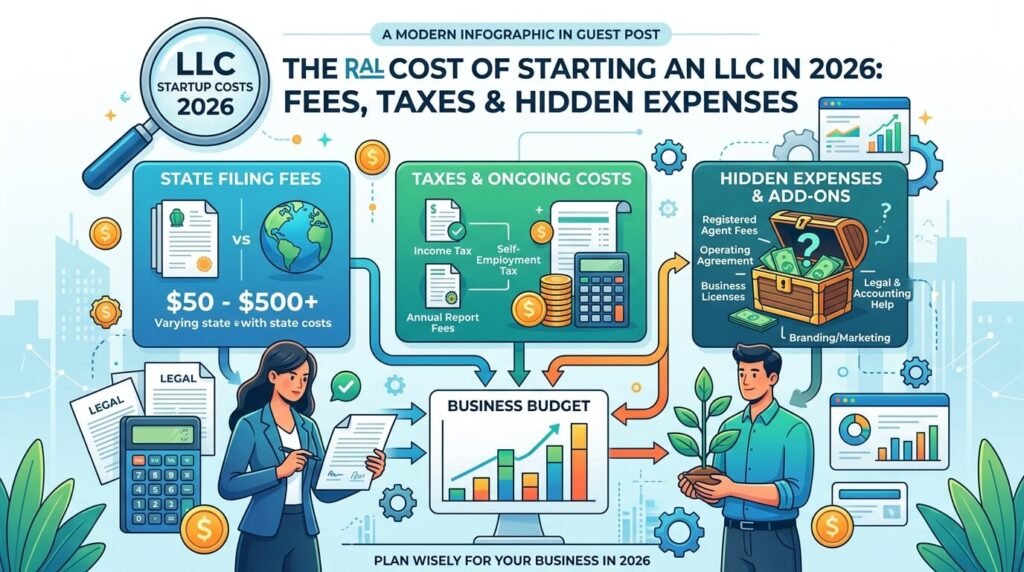
So, how much does an LLC actually cost in 2026? At USA Business Daily, we’ve found the state filing fee alone runs anywhere from $35 to $500 — it really just comes down to where you’re setting up shop. But here’s the thing: that fee is nowhere near the full picture. Once you factor in a registered agent, annual reports, franchise taxes, and whatever licenses your business needs, most owners are looking at $100 to $1,000 out the door in year one. And in some states, it climbs a lot higher than that. Take California — you’ll owe an annual tax there whether your LLC turns a profit or not.
This guide breaks the cost to start an LLC into three honest groups. There is what you must pay. There is what you will likely pay. And there is what you might choose to pay. It also includes a full state-by-state fee table. Use it to budget for your own state instead of guessing from a national average. If you haven’t filed yet, our How to Start an LLC guide walks through the process step by step.
Why The Real LLC Cost Matters In 2026
Small businesses are not a side story in the U.S. economy. They are most of it. As of February 2026, the SBA Office of Advocacy counted 36.2 million small businesses in the country. That is 99.9% of all U.S. businesses. Small businesses also employ 62.3 million people. That’s 45.9% of the private-sector workforce, and they generate 43.5% of GDP.
Every one of those businesses started somewhere. Many started as an LLC filing.
Here’s why getting the real number right matters more in 2026 than it used to. State fees, annual reports, and franchise taxes have all shifted over the past few years, sometimes upward. A number you saw quoted two or three years ago may already be out of date. Budgeting from an old or generic figure can leave a new owner short on cash exactly when they need it most, in the first few months of running a business.
There’s a second reason this matters. Bureau of Labor Statistics data shows that only 57.3% of businesses started in 2018 were still operating five years later. Cash reserves matter during that stretch. Every dollar spent on an unnecessary formation add-on is a dollar not available for inventory, marketing, or simply staying open during a slow month. Knowing your real LLC cost upfront, not just the filing fee, is a practical survival tool, not just an SEO talking point.
That’s the gap this guide fills. It separates the fee you must pay today from the costs that show up later, so you can plan your first year with real numbers instead of a rough guess.
LLC Cost At A Glance
| Cost item | Typical situation |
| State filing fee | Required in every state |
| Registered agent | Often required, but owners can often serve for free |
| EIN (Employer Identification Number) | Free directly from the IRS |
| Operating agreement | Often $0 if written yourself |
| Annual report or biennial report | Required in most states |
| State taxes or franchise tax | Depends on your state and revenue |
| Business licenses and permits | Depends on your industry and city |
| LLC formation service | Optional, usually 0–300 plus state fees |
| Attorney | Optional, usually $500 and up |
| Business insurance | Depends on your industry and risk exposure |
How Much Does It Cost to Start an LLC?
Most guides answer this question with a single number. That number is misleading. An LLC actually has three separate cost layers. New owners often mix them up when budgeting.
Minimum formation cost. This is the state filing fee for your Articles of Organization. It is the smallest amount you can legally spend to create an LLC. It ranges from $35 in Montana to $500 in Massachusetts.
Realistic first-year cost. This adds the extra costs most owners pay in year one. That means a registered agent, if you don’t act as your own. It means any required annual report. It also means a basic operating agreement and any license your city requires. For many single-member LLCs, this lands between $100 and $400.
Professional first-year cost. This adds optional help. Think of a formation service, an attorney, an accountant, or business insurance. Depending on how much support you buy, this can run from $500 to well over $2,000.
Know which layer you are budgeting for before you file. That is the single most useful step you can take. A generic LLC startup cost figure from a blog post may skip your state’s annual fee entirely. Always check the specific line items yourself.
LLC Formation Costs Explained
State Filing Fee
Every state charges a one-time fee to file your Articles of Organization (sometimes called a Certificate of Formation). This is the fee that most “how much does an LLC cost” articles quote, and it is the true starting point of your LLC filing fee budget. See the full LLC Cost by State table below for your specific state.
Registered Agent
A registered agent receives legal notices and state mail on behalf of your LLC. This can be a person or a company. Most states require one. In many states, you can act as your own agent for free. You just need a physical address in that state and normal availability during business hours. Hire a commercial service instead, and expect to pay roughly $100 to $300 per year. Learn more in our guide to What Is a Registered Agent?
EIN (Employer Identification Number)
An EIN is a federal tax ID number issued by the IRS. It is completely free when you apply directly through IRS.gov. Some formation services charge $50 to $100 to “obtain” one for you. That fee only pays for convenience. The underlying number itself costs nothing. See our step-by-step How to Get an EIN guide to file it yourself in minutes.
Operating Agreement
An operating agreement outlines ownership, management, and profit-sharing rules for your LLC. Some states require one internally. Most, though, do not require you to file it with the state. Writing a basic single-member agreement yourself costs nothing. A custom multi-member version drafted by an attorney can cost $200 to $1,000 or more. Our LLC Operating Agreement guide walks through both approaches.
Business Licenses and Permits
Depending on your industry, city, and county, you may need a general business license, a seller’s permit, a health permit, or a professional license. These costs vary enormously, from $0 in some jurisdictions to several hundred dollars in others, and they are usually separate from your LLC filing fee entirely. See our Business License Guide to check what your specific business and location require.
DBA / Assumed Name Registration
If you plan to operate under a name different from your LLC’s legal name, you may need to file a DBA (doing business as) or assumed-name registration. Fees typically range from $10 to $100, depending on the state and county.
Hidden LLC Costs You May Not Expect
The costs above are the ones most guides cover. These are the ones that catch new owners off guard.
- Annual or biennial reports. Most states require this recurring filing to keep your LLC in good standing. Skip it, and your state can dissolve your LLC.
- Franchise or privilege taxes. Some states charge a flat or income-based tax on LLCs. This is separate from the filing fee you already paid.
- Publication requirements. New York and Arizona require new LLCs to publish a notice in local newspapers. This can add hundreds, even over a thousand dollars, beyond the filing fee.
- Registered agent renewals. Use a commercial registered agent, and you’ll pay that fee again every year.
- Foreign qualification. Form your LLC in one state but do business in another? You may need to register as a foreign LLC there too, and pay that state’s fees.
- Accounting and tax preparation. Your LLC’s income still needs to be reported. Many owners underestimate this recurring cost when they first budget.
The Real LLC Cost Formula
Here is the formula this entire guide is built around:
Real LLC cost = state filing fee + mandatory state fees/taxes + registered agent + licenses/permits + optional professional services + accounting/compliance costs
To make that concrete, here are two illustrative scenarios. Treat both as examples, not universal prices, since your state and business will change the numbers.
DIY first-year budget (low-cost state)
- State filing fee: $100
- Registered agent (self-served): $0
- EIN (from IRS.gov): $0
- Annual report: $100
- Estimated total: $200
Professional first-year budget (higher-cost state)
- State filing fee: $200
- Commercial registered agent: $150
- Formation service fee: $150
- Basic business license: $75
- Annual report or franchise tax: $300
- Estimated total: $875
The gap between $200 and $875 is not a mistake in either article. It is the real range created by state choice and how much outside help you buy. That range is exactly what a single national average hides.
LLC Cost by State in 2026
State fees change from time to time. Treat this table as a starting point, and confirm the current fee with your state’s Secretary of State office before you file. Figures below reflect standard online filing. They were verified against aggregated Secretary of State data current as of February 2026.
| State | Filing Fee | Annual/Biennial Report | State Income Tax | Franchise Tax |
| Alabama | $236 | None | Yes | Yes |
| Alaska | $250 | $100 | No | No |
| Arizona | $50 | None | Yes | No |
| Arkansas | $45 | $150 | Yes | No |
| California | $70 | $20 (plus $800 annual tax) | Yes | Yes |
| Colorado | $50 | $10 | Yes | No |
| Connecticut | $120 | $80 | Yes | No |
| Delaware | $110 | $300 | No | Yes |
| Florida | $125 | $138.75 | No | No |
| Georgia | $100 | $50 | Yes | No |
| Hawaii | $50 | $15 | Yes | No |
| Idaho | $100 | None | Yes | No |
| Illinois | $150 | $75 | Yes | No |
| Indiana | $95 | $32 | Yes | No |
| Iowa | $50 | $30 | Yes | No |
| Kansas | $160 | $50 | Yes | No |
| Kentucky | $40 | $15 | Yes | No |
| Louisiana | $100 | $30 | Yes | No |
| Maine | $175 | $85 | Yes | No |
| Maryland | $100 | $300 | Yes | No |
| Massachusetts | $500 | $500 | Yes | No |
| Michigan | $50 | $25 | Yes | No |
| Minnesota | $155 | None | Yes | No |
| Mississippi | $50 | None | Yes | No |
| Missouri | $50 | None | Yes | No |
| Montana | $70 | $20 | No | No |
| Nebraska | $105 | $13 | Yes | No |
| Nevada | $75 | $150 | No | No |
| New Hampshire | $100 | $100 | No | No |
| New Jersey | $125 | $75 | Yes | No |
| New Mexico | $50 | None | Yes | No |
| New York | $200 | $9 (plus publication cost) | Yes | No |
| North Carolina | $125 | $200 | Yes | No |
| North Dakota | $135 | $50 | Yes | No |
| Ohio | $99 | None | Yes | No |
| Oklahoma | $100 | $25 | Yes | No |
| Oregon | $100 | $100 | Yes | No |
| Pennsylvania | $125 | $7 | Yes | No |
| Rhode Island | $150 | $50 | Yes | No |
| South Carolina | $110 | None | Yes | No |
| South Dakota | $150 | $50 | No | No |
| Tennessee | $300 | $300 | No | Yes |
| Texas | $300 | None | No | Yes |
| Utah | $54 | $18 | Yes | No |
| Vermont | $125 | $35 | Yes | No |
| Virginia | $100 | $50 | Yes | No |
| Washington | $180 | $70 | No | No |
| West Virginia | $100 | $25 | Yes | No |
| Wisconsin | $130 | $25 | Yes | No |
| Wyoming | $100 | $60 | No | No |
| District of Columbia | $99 | $300 | Yes | No |
Source: aggregated Secretary of State filing data, verified February 2026; California and Texas figures cross-checked against the California Franchise Tax Board and Texas Comptroller. Fees can change, so confirm before filing.
Want the complete state-by-state breakdown of recurring costs specifically? See LLC Annual Fees by State for the full picture.
Real LLC Cost Examples
Generic ranges are hard to plan around. These real examples show why the same LLC can cost very different amounts depending on where you form it.
California. A California LLC pays a $70 formation fee. But that is not the number that matters most. California also charges an $800 minimum annual LLC tax. This comes from its 2026 Franchise Tax Board rules. The tax applies even if the business earns no profit. That is why California is one of the most expensive states to maintain an LLC in, despite its cheap filing fee. See our California LLC Cost guide for the full breakdown.
Florida. Florida charges a $125 formation fee and a $138.75 annual report fee. Florida has no state income tax. That can offset some of the ongoing cost for profitable businesses. Full details are in our Florida LLC Cost guide.
Texas. Texas charges a $300 formation fee. It has no traditional annual report. LLCs are still subject to the state’s franchise tax, though. For the 2026–2027 period, the no-tax-due threshold is $2.65 million in annualized revenue. Most small LLCs owe nothing, but they may still need to file a report confirming that. See our Texas LLC Cost guide.
New York. New York’s $200 filing fee is only the starting point. New York LLCs must also meet a publication requirement. That means placing notices in two local newspapers for six weeks straight. Then you file a Certificate of Publication for a $50 state fee. Add the newspaper costs, and this can run from several hundred to well over a thousand dollars, depending on the county. Read our New York LLC Cost guide for county-specific estimates.
A low-cost state example. Take Kentucky. Serve as your own registered agent. Write a basic operating agreement yourself. Get a free EIN from the IRS. Do all three, and you can form and maintain a Kentucky LLC for close to $55 in year one: a $40 filing fee plus a $15 annual report. See our Best States to Form an LLC guide before you assume the cheapest filing fee is always the right choice.
How Much Does an LLC Cost Every Year?
Formation costs and recurring costs are not the same thing. Confusing them is one of the most common budgeting mistakes new owners make.
Ongoing annual expenses typically include:
- Annual or biennial report fees, which range from $0 in states like Missouri and New Mexico to $500 in Massachusetts.
- Franchise or privilege taxes, which apply in states like California, Delaware, and Tennessee regardless of the filing fee.
- Registered agent renewal, if you use a paid service rather than acting as your own agent.
- Accounting or tax preparation fees, which scale with how complex your business finances become.
- License renewals, for any permit that requires periodic renewal.
- Business insurance premiums, if your industry or landlord requires coverage.
A realistic recurring LLC annual fee budget for a simple single-member LLC with no employees typically falls between $50 and $300 per year. That is before any optional professional services. For a deeper look at how LLC profits are taxed at the federal and state level, see our LLC Tax Guide.
DIY vs LLC Formation Service vs Attorney
| Factor | DIY | Formation Service | Attorney |
| Cost | Lowest — state fee only | Moderate — state fee plus 0–300 service fee | Highest — often $500+ |
| Convenience | Lower, you handle every step | Higher, guided process | Higher, fully handled |
| Legal advice | None | Limited, and varies by provider | Yes |
| Best for | Simple, single-member LLCs | Owners who want guidance without legal fees | Multi-member LLCs or complex ownership structures |
There is no universally “best” option here. A freelancer forming a simple LLC in their home state may need nothing more than a direct state filing and a free IRS-issued EIN. A group of co-founders splitting equity, or a business in a regulated industry, usually benefits from an attorney. This is especially true for the operating agreement. Compare providers directly in our Best LLC Formation Services roundup. Or read LLC vs Sole Proprietorship if you are still deciding whether you need an LLC at all.
How to Reduce Your LLC Startup Costs
You can legally lower your LLC formation cost without cutting corners on compliance:
- File your Articles of Organization directly with your state. Skip the formation-service markup for a step you can do yourself.
- Get your EIN directly from the IRS website. It takes minutes, and it is always free.
- Serve as your own registered agent if your state allows it. You just need a reliable address during business hours.
- Use a basic operating agreement template for a simple LLC. Only pay for a custom one if your ownership structure is complex.
- Confirm which licenses you actually need before you buy any. Requirements depend on your industry and location, not your business structure.
- Check your state’s annual report and franchise tax rules first. A cheap filing fee can hide an expensive recurring cost.
Is an LLC Worth the Cost?
This is not a yes-or-no question. Be skeptical of any article that tells you it is.
An LLC is generally worth the cost when personal liability protection matters to you. It also helps when you want a more credible structure for contracts and banking, or when your business carries real legal or financial risk. It may matter less for a very early, low-risk side project, where a sole proprietorship is simpler and cheaper to run. Bureau of Labor Statistics data shows the five-year survival rate for businesses started in 2018 was 57.3%. That’s a useful reminder: don’t overspend on formation before your business has revenue to protect. Weigh your state’s fees, your industry’s risk, and your growth plans before you decide. For a side-by-side look, see LLC vs Sole Proprietorship.
Frequently Asked Questions
How much does it cost to start an LLC in 2026?
State filing fees range from $35 to $500. Most owners should budget $100 to $400 for a realistic first year, once registered agent, annual report, and license costs are added.
How much does an LLC cost per year?
Recurring costs for a simple single-member LLC typically run $50 to $300 per year, though states like California and Massachusetts charge significantly more.
What is the cheapest state to form an LLC?
Kentucky has the lowest filing fee at $40, followed by Arkansas at $45 and several states tied at $50. Recurring fees matter as much as the filing fee, so check both before choosing.
What is the most expensive state to form an LLC?
Massachusetts has the highest filing fee at $500, plus a $500 annual report. California’s $800 minimum annual tax also makes it one of the priciest states to maintain an LLC over time.
Is an LLC free to start?
No state offers a completely free LLC filing, though a few states charge as little as $35 to $50.
Is an EIN free?
Yes. The IRS issues EINs at no cost when you apply directly at IRS.gov. Third-party sites that charge a fee are charging for convenience, not a lower official price.
Do I need a registered agent?
Most states require one. You can often serve as your own registered agent for free if you meet your state’s address and availability requirements.
How much does a registered agent cost?
Commercial registered agent services typically charge $100 to $300 per year.
Do I need an operating agreement?
Some states require LLCs to keep one internally, even without filing it publicly. It’s good practice for every LLC, especially ones with multiple members, no matter what your state requires.
Do LLCs pay taxes?
LLCs are usually pass-through entities for federal taxes. Profits pass to the owners’ personal tax returns, unless the LLC elects corporate taxation instead. Some states also charge a separate franchise or privilege tax.
Can I form an LLC myself?
Yes. Filing your own Articles of Organization is legal in every state and is often the most cost-effective option for simple, single-member LLCs.
Do I need a lawyer to form an LLC?
Not for a simple structure. An attorney becomes more valuable for multi-member LLCs, complex ownership splits, or industries with heavy regulation.
What are the hidden costs of an LLC?
Annual reports, franchise taxes, publication requirements, registered agent renewals, and foreign qualification fees are the costs new owners most often overlook.
Can I run a business without an LLC?
Yes. Many small businesses operate as sole proprietorships or general partnerships, which cost less to maintain but do not provide the same personal liability protection.
What happens if I don’t pay my LLC’s annual fee?
Your state can administratively dissolve your LLC, which removes your liability protection and can create complications if you later try to reinstate it.
The Bottom Line
At the end of the day, the filing fee is just the opening number in your LLC cost 2026 budget — what you actually pay comes down to your state, your industry, and how much help you decide to bring in along the way. That’s exactly where USA Business Daily comes in, walking you through the real costs and trade-offs so you’re not guessing. Pull your numbers from the state table above, figure out which of the three cost layers matches your situation, and double-check the final fees with your state before you actually file.
Calculate your estimated first-year LLC cost, or check your state’s exact filing and annual fees, before you file.